


.png)
LISTEN NOW





What does it take to build an e-commerce brand that lasts for more than two decades?
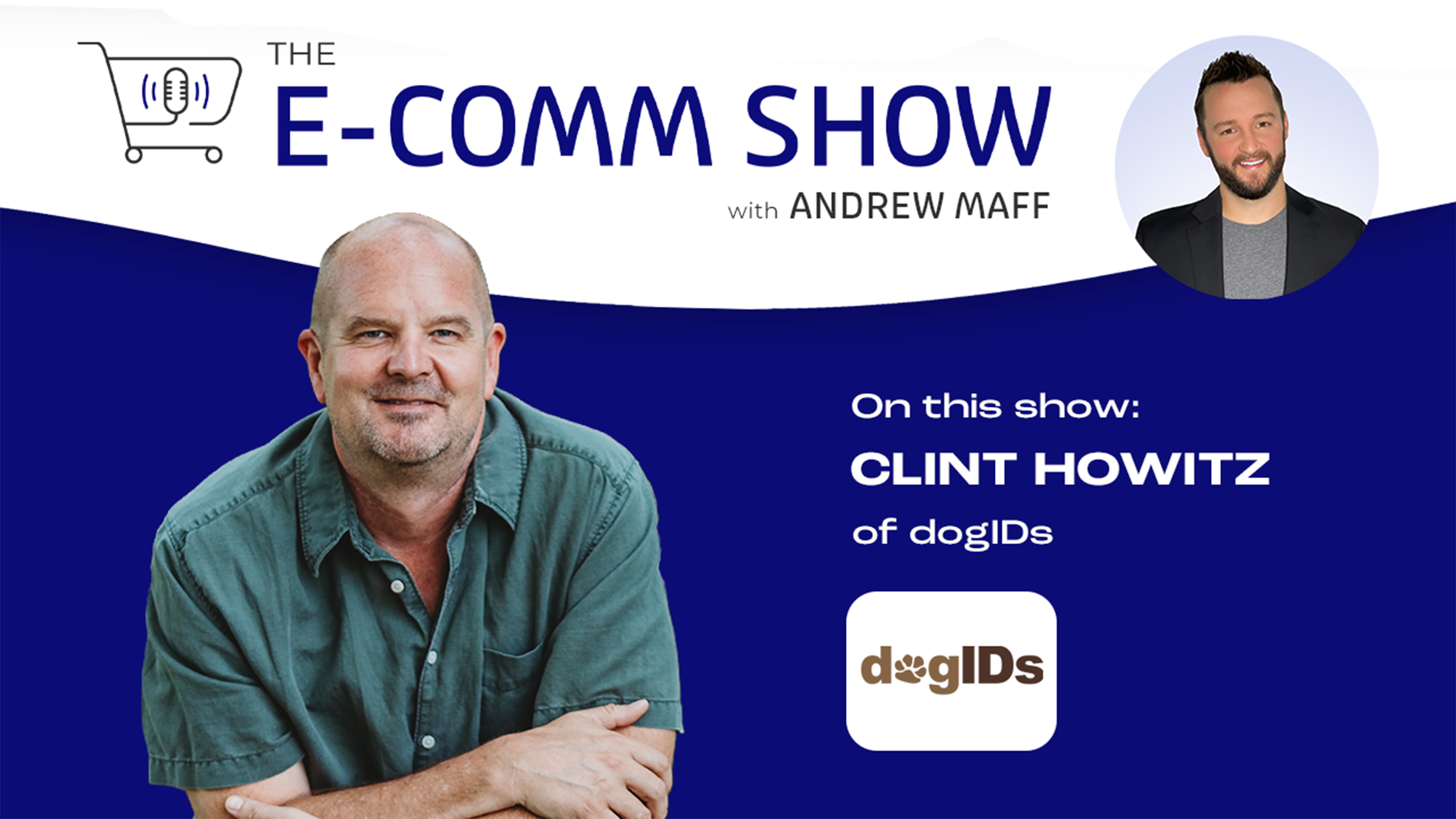
In this 237th episode of The E-Comm Show, host Andrew Maff sits down with Clint Howitz, Founder and CEO of dogIDs, to discuss the realities of building and growing a direct-to-consumer brand in an increasingly competitive e-commerce landscape.
From starting with handcrafted dog collars and personalized ID tags to growing dogIDs into a nationally recognized pet brand, Clint shares the lessons he's learned over 20+ years of entrepreneurship. The conversation explores the evolution of DTC, the challenges of manufacturing products in-house, why focusing beats trying to be everywhere at once, and how AI is beginning to reshape how consumers discover brands online.
What You'll Learn:
-
Why Focus Beats Being Everywhere: How choosing the right sales channels (and saying no to the wrong ones) helps brands avoid spreading themselves too thin.
-
The Reality of Manufacturing Your Own Products: The biggest operational challenges of producing products in-house, from sourcing materials to maintaining quality.
-
How dogIDs Built a Loyal Customer Base: Why customization, craftsmanship, and customer experience continue to outperform short-term marketing tactics.
-
The Evolution of Direct-to-Consumer: How the DTC landscape has changed over the past two decades and what brands need to do to stay competitive.
-
AI and the Future of Product Discovery: Why AI-powered search may fundamentally change how customers find brands and why that could benefit businesses with authentic products.
-
The Challenges of Scaling Manufacturing: How labor shortages, rising costs, and sourcing issues are changing the economics of producing products domestically.
-
Balancing Growth with Operational Excellence: Why growing too quickly can create just as many problems as growing too slowly.
-
Building a Business That Lasts: The mindset, resilience, and long-term thinking required to stay relevant in e-commerce for more than 20 years.
Watch the full episode below or visit TheEcommShow.com for more.
If you enjoyed the show, please rate, review, and SUBSCRIBE!
Have and e-commerce marketing question you'd like Andrew to cover in an upcoming episode? Email: hello@theecommshow.com
WATCH ON YOUTUBE
ABOUT THE GUEST
Clint Howitz
Clint spent many years in corporate positions at companies like Ford Motor Company and Bobcat Company prior to finally accepting that creating via entrepreneurship is his only true path for him. dogIDs is the third e-commerce business he has started in the pet industry since the late '90s and dogIDs is now 21 years old. Over these 21 years, Clint has received an education way above and beyond what he could have imagined and he claims that experience is his one and only teacher. His passion for dogs and creating with a little bit of tenacity sprinkled on are what have kept him going through the years. If it was easy, it would be unrewarding to him and he would have thrown in the towel many years ago.
Episode Transcript
iconClint Howitz 00:03
It's trade-offs, picking battles you know? That's really what it comes down to. And because the land, the space has become so crowded and competitive over the last several years, yeah, we have to be careful about that. You get spread too thin. Next thing you know, you're doing a half-assed job in every single channel you're in.
Narrator 00:21
Welcome to the E-comm Show podcast. I am your host Andrew Maff, owner and founder of Bluetuskr. From groundbreaking industry updates to success stories and strategies, get to know the ins and outs of the e-commerce industry from top leaders in the space. Let's get into it!
Andrew Maff 00:32
Hello, everyone. Welcome to another episode of the Ecomm Show. As usual, I'm your host Andrew Maff. Today, I'm joined by the amazing Jacob Johnson, who is the founder and CEO over at Calyan Wax Co., Jacob. How you doing, buddy? Ready for a good show?
Andrew Maff 00:35
Hello, everyone. Welcome to another episode of the E-comm Show. As usual, I'm your host Andrew Maff, and today I'm joined by the amazing Clint Howitz, who is the founder CEO over at Dog IDs. Clint, how you doing, buddy? Ready for a good show?
Clint Howitz 00:48
Yeah, yeah. Nice to be here. Appreciate the invite.
Andrew Maff 00:52
Yeah, I'm super excited to have you on the show. Years ago before I even started BlueTusker, I was in the pet industry for a while. It's a super interesting world, there's a lot to learn about. It's a challenging industry as well, so I'm super excited to get into it. But I always like start these off relatively stereotypically. I just want to give you the floor. Tell us a little bit about your background, how you got started with dog IDs, and we'll take it from there okay?
Clint Howitz 01:18
Sure. It all started back in the '90s when myself and my brother started a business. We were making high-end specialty products for mainly sporting dogs, working dogs, but we were really heavy into the sporting dog industry, dog training, hunting dogs, that kind of stuff. So that was driving it. And as that went, well, I realized that as we were going to Ducks Unlimited trade shows and all these big, big consumer trade shows, you know, I realized that the most important thing people were trying to find are nameplates for collars. You know, so basically, we brought all of our products with, but the whole day we had a line to the booth every time for people wanting to get a nameplate engraved and riveted onto their dog collar, you know, because there was just nowhere to get that done anywhere, right? Unless you knew somebody had a harness shop or something like that, and that's a little detail I did leave out too. I used to work with a guy in northern Minnesota. He had a a long standing harness shop. He specialized in like horse teams, so there was only like two people in the world that actually did the work that he did. So he had accounts with Walt Disney and all these big, huge tourist places in Montana and that kind of thing, where he was making harness harnesses for team horse teams like draft horn harness draft horse harness stuff like that very specialized.
Clint Howitz 03:08
So, anyways, I got was working with him on some stuff and started making lots of leather products for dogs, obviously, and that's how I learned a lot of it from him. And after we got into it, the personalized nameplates, like I was saying, just that was everything. Yeah, it's a tiny little item. It's not very sexy to most people because you can't make $100 every time you sell one. But that's what everybody wanted. And back then we were using like diamond drag engravers, or you know, they didn't. They did the job, but they didn't really show the text very well. They didn't last that long. You'd have to get a new one every couple years, especially if you had a working dog out in the woods every day rubbing on stuff. So that kind of dominated the focus going forward. So in between there, some things happen, but eventually, I jumped in with both feet to get dog IDs going, and so founded it in 2002 and it was just kind of a little hobby thing I did on the side, and my wife also, and then after a few years, like this is insane. Let's just-I'm going to jump into those both feet and see how it goes. And that was-that was a good thing.
Clint Howitz 04:30
Clint Howitz 04:30
Yeah, this is always a fun thing. Like, okay, we're talking human trafficking. We're talking like family story. Why candles? It was a product that caught my eye. I have a little obsessive tendency, but it caught my eye as a product that people understand they already purchase, they consume that has metaphorical ties to bringing light to a dark world. Something we could manufacture ourselves at small scale, relatively simple. Simply scaling has been very difficult, and something that if hey we hit the quality mark, you'd want to buy again and again. And candles just kind of fit the strategic bill there. And so I was like, all right, I I think we could build this around candles, and now it's around home fragrance. And so, not a specific love for candles. I've grown to appreciate home fragrance, and it's been a really good choice. God had His hand over that decision. It was very. It sounds sophisticated. It wasn't. I was 21 years old, thinking of a product I could try to sell, but it's been a good category. I'm glad we chose it.
Andrew Maff 05:29
Yeah. So it's very, it's a very interesting area because it's not just like traditional dog tags. Like it's dog IDs mostly on the working dog side. Correctly, is there is this mostly? Would you say this is mostly like a B2B play. Like, which type of customer are you going after?
Clint Howitz 05:44
It used to be B2B used to be a really big focus. So back in the 90s, especially, everything was three stepping. Right, that's what I knew. I came from my corporate experience. I worked for Ford for a while, and Bobcat, and big manufacturers. There's three stepping everything. That's kind of what I knew. That's my comfort zone, right? So that's how kind of it started. But once we started getting into things in that you know, 2012, 15, 16 range, it all started going to no. This is direct consumer, and it maybe isn't going to be here for 10 years, but that's where it's going. So we started just focusing on that as much as we could, and we still do a little bit of B2B We do, but it oh boy, there's trade-offs with everything. Let's just put it that way, right? There's B2B takes a lot more handholding, a lot more.
Andrew Maff 06:52
They want a rep.
Clint Howitz 06:53
Yeah, there's a lot of complications there, right? Direct to consumer has their comp has its complications too. A lot of people don't really like working directly with customers, especially if you're selling, like you just mentioned, if we're selling products that are mainly designed for working dogs and sporting dogs, professional level dogs, and you're selling those to companion animal customers that don't really care about that stuff, then there's a lot of explaining to do there too, you know.
Andrew Maff 07:27
Yeah.
Clint Howitz 07:28
Yeah, there's trade-offs, but it's definitely back then we were thinking, you know, this personalized products, just not personalized dog products, but personalized products in general. There's going to be a point on the internet where it's just going nuts, right? Custom, custom products, and I think we're just on the cusp of that now, 20 years later, right? So I'm excited for that, but at the same time, now the space has become so crowded. Oh my God!
Clint Howitz 08:00
Everybody that used to make furniture and watches and who knows what in the past-they're jumping in. They're money chasers, right? They want to get in and get a piece of the pie. Now that the foundation has been built by the trailblazers, let's get in there and get it. Now the risk is low, right? So that's that's been going on probably, especially the last five to 10 years. Not saying that's wrong. It's always going to be that way, but the landscape is a lot different now. It's crowded. It's there's a lot of people jumping in, and like I said, it's not all just people with dog passion behind them. There, there's people with big money behind them, and they're just all about million dollar, you know, multi million dollar marketing budgets.
Andrew Maff 08:40
Yeah
Clint Howitz 08:41
That's different. That's different.
Andrew Maff 08:43
Oh yeah, you do have the added benefit. Like dogides.com. is a fantastic domain to grab, so it makes it a lot easier for people to be able to find you. Are is most of the business happening through your website, or are you selling on any other marketing or any other sales channels like in Amazon or something like that?
Clint Howitz 08:58
We do some in Amazon too, and then a little bit of Etsy, and then that's about the only marketplaces we're really focused on right now. Other than our own domain.
Andrew Maff 09:12
Yeah. I mean, it's that customization element. I actually literally just had a call with someone yesterday that has a custom element to it, and the just constant complaints about how limiting the Amazon side is, which is kind of a good thing because then Amazon's a great way to kind of get people to learn who you are, but then they leave and they go to your website because they want to make sure that it actually looks the way they want it to because Amazon's customizations are so poor. Is most so with most of the revenue coming through the website? How do people find you? Like, is it through organic? Are you doing social media, social ads? Like what's been the approach there?
Clint Howitz 09:47
We haven't been doing much on the social side, especially over the last three or four years. A little bit. We're putting imagery out and you know some automated stuff, but. We just haven't really been doing a lot with the social media stuff. It's just its trade offs, picking battles. You know, it that's really what it comes down to. And because the land, the space has become so crowded and competitive over the last several years, yeah, we have to be careful about that. You get spread too thin. Next thing you know, you're doing a half-assed job in every single channel you're in, right?
Andrew Maff 10:25
Oh yeah. So is most of that traffic coming like through search, Google Ads, something like that, organic, a little bit of both.
Clint Howitz 10:32
Yeah, search and our customer base, you know, direct traffic. But there's competitors that have figured out at this point how to steal that too, right? And that's been gradually going on over the last five years or so. But that's that's really if we didn't have that right now, I don't know how we would even compete unless you have a big, a big backer that's you know willing to risk some money on marketing costs and stuff, right?
Andrew Maff 11:07
Yeah. Are you like with a product line like yours, and especially with a domain like yours? I would expect you're seeing starting to see more and more sales coming through like ChatGPT or Perplexity or Google's Gemini things like that. Are you starting to see more of that coming in?
Clint Howitz 11:24
Yeah, it's still really difficult to track black and white. Yeah, you can you can tell that that's where it's shifting, right?
Andrew Maff 11:34
Yeah.
Clint Howitz 11:35
People are posing questions. AI is helping them answer those questions and find what they need, yeah, and I don't know. A part of me is kind of happy about that. I'm sick of the gaming, and you know, the gaming has kind of gone away, right? But you know what I'm talking about. All the things that you have to do to be here, right? It's let's just be real and let the customers come where they want to come, and I think AI is going to do a better job at helping those people do that without sounding too vague.
Narrator 12:12
Is our e-commerce business experiencing falling revenue? Bluetuskr has helped many brands like yours excel. Unlike other marketing partners, Bluetuskr leverages a team of specialists to ensure every strategy is created and executed toward your business growth. As an extension of your marketing team, Bluetuskr prides itself on helping to fill in the gaps and develop strong omni-channel strategies to diversify your business from the rest. Ready to scale your marketing initiatives? Visit their website, bluetusker.com. That's b l u e t u s k r.com
Andrew Maff 12:44
No, I think it'll do. I think it's going to do a great job to really kind of cut out a lot of the noise. Like to your point of, you get companies that are just checking boxes, kind of thing. I think this year, this q4 I think is going to be very interesting for that realm because I feel like this is going to be the first year where it's a little bit more-it's a little bit more likely that the consumers are going to leverage AI in Q4 to help them with some of their shopping, and so it'll be really interesting to see what that growth looks like. I know Amazon with Prime Day. I think they said that there was like double the amount of people leveraged their AI to help shop. But you also take that with a grain of salt because two times one is two. So like, it really wasn't a huge number in the first place. Yeah, yeah. But it'll be interesting to see what happens this year?
Clint Howitz 13:41
Yeah, but I think the confidence is coming up, right? That's the part that nobody can really predict. Like QR codes, they're still not catching on in the states. They've been super popular in Asia and everything, right, for decades, and they're just kind of catching on here finally because more people have the automated QR readers on their cameras, I would say that's kind of comparable. AI is way bigger, way bigger deal, but it takes a while for people to get comfortable, and there's a lot of negativity going around too about AI, the scary stuff, right?
Andrew Maff 14:19
It's always skeptics.
Clint Howitz 14:23
Yeah, definitely, definitely. So it just depends on the comfort level with the people on the end that are using it, what they want to use, what they're comfortable using. But I think we're at the point where there's definitely a tipping point where people are starting to become dependent on this agent in their pocket, right?
Andrew Maff 14:45
Oh yeah.
Clint Howitz 14:45
It's happening. It's happening.
Andrew Maff 14:51
Just remind me too of something I wanted to ask you. So you are also manufacturing. So obviously there's brands that that's usually not the. The route that they want to go right. So you're doing both manufacturing and obviously the front end D2C is that going for you? I know obviously margin probably makes margins a little bit better, but I know that there's
Clint Howitz 15:11
There's a trade off
Andrew Maff 15:12
Pros and cons to dealing with manufacturing in house.
Clint Howitz 15:16
Yes, and I would say the manufacturing side is way more complicated and challenging than anything, you know.
Andrew Maff 15:24
Yeah, the margins are better if you can do that. But boy, it can really be a thorn in your side too most weeks, right? I I always kid, I should wear a Maytag repairman hat to my office over there. It was always something to fix. Always something you know isn't working right. You know, and that's a time suck. You know, it really is. It's an energy suck.
Clint Howitz 15:50
But what I like, and this is just a personal thing. I'm not saying what's right or wrong, but for me, what gives me satisfaction is to make a product from scratch out of nothing, have it in my hand, and show it to someone, and have them grab it and go, "Oh, I really like this, right?
Andrew Maff 16:14
Yeah.
Clint Howitz 16:15
That's there's a tactile connection there that has to be there for me, you know. Some people are okay with just dropshipping whatever. If they never see a product in their hand, that's fine. They're going to sell it to the customer and make money. That's all they care about. Or they'll have other people manufacture because there's really good manufacturers out there, and it's a really really long road to learn that, right? And it's expensive, and it's challenging, and it's frustrating. So, yeah, I could go on and on, but you hit the nail.
Andrew Maff 16:55
Dealing with the amount of people you got to have in there, stuff always breaking. But to your point, it's a trade-off of you know you get that real quick and easy quality assurance that you can't do where you have more control over the overall experience that your customer is getting, which is sounds like what's keeping people coming back to you, and you know so it's kind of like a it's a pain, but you take the wins with the losses, kind of thing.
Clint Howitz 17:23
I totally agree. And one other point on that too is, you know, what feels really good is when somebody calls or chats or emails with you on the customer service side, and it's right there. Let me go look quick. Oh yeah, know exactly what's going on with that. So and so probably missed this, you know. It's very powerful, right? And the customers feel that. So and then if we do need to make a modification, we can, you know, because we are a custom manufacturer, so that's important, right?
Andrew Maff 17:58
With the raw materials that you're bringing in, are those coming from the states? Do they come from overseas? If they are overseas, are you having issues with? I know tariffs have kind of slowly gone away, give or take. But some of them are obviously still here. What's what's going on there?
Clint Howitz 18:14
We source most things from the states, especially any strap we use and whatever we can. We source from the U.S.
Andrew Maff 18:21
Yeah.
Clint Howitz 18:22
Hardware is kind of a swear word around our office because it's just it's difficult, right? So, and over the years, you're right. The tariffs changed things up. Some our hardware sources they won't even send out price lists anymore. You have to email them, find out what the prices are this month. Order that can screw up your cogs in a really big hurry, right? Yeah. And the reason for that is because most of the hardware we use is small pieces. The people in the states, most of the manufacturer that are that are working with forging and you know, die cutting and CNC and all that stuff. They don't want to make little little metal pieces for dog collars. They want to make valve bodies for automobiles and heavy equipment. You know, you know, $1,000 pieces of $1,000 items, not little 123, dollar items, right? Yeah. So all of that stuff is still made in Asia. There's a couple little tiny pockets in the states that they're doing it, but it's really expensive. So we try to do both, and what that forces you to do is just work through brokers because everybody's buying through brokers in the states for hardware. You know.
Andrew Maff 19:39
Yeah.
Clint Howitz 19:39
We're not the only ones. It's just the way it is.
Andrew Maff 19:42
Yeah, I got to say, Clint. So normally around this time, one of my favorite questions to ask is about you know what are you struggling with right now? Because a lot of times I get on these calls, we do these interviews, and I'm speaking to other founders, and so founders love to talk about their business. They like to talk about how awesome it is and how it's growing and blah blah. And I love that you were honest of just like, hey, no, these are the real world problems that we're having right now. So I guess I'll flip the question a little bit on you. A, I would I would be interested still to know like it sounds like it's manufacturing, but what is it that's keeping you up at night? And then what is it that you're super happy with like we just are crushing it at this right now.
Clint Howitz 20:26
I would say most of the things that keep me up at night are the um oh boy that's a tough one. Manufacturing for sure because it's just always very complicated, right? It's not a simple answer ever, and having the right partners on that side is very important too for sourcing
Andrew Maff 20:46
Yeah.
Clint Howitz 20:47
Yeah so I would probably say that's the biggest challenge still the robots haven't arrived yet you know.
Andrew Maff 20:57
In time.
Clint Howitz 20:58
Yeah and there's probably going to be trade-offs with that as well, right? The workforce has changed quite a bit, and I try to try to walk gingerly around this because I'm an old guy at this point. I have totally different ideals from my generation compared to our, and I see the positives in the new generations too. I'm like, God, I wish I would have been thinking like that when I was their age, you know. But it's different when you're trying to run a business and you have these ideals that you built your business on, and then and then you're bringing people in that don't really align with that anymore. You can't just can't keep the doors. You can't just keep the rotating door going. You have to adjust on your side too, right? And just realize that okay, like I said earlier, my ideals are different, and I need to either adapt and compromise here, or I'm not going to find anybody.
Andrew Maff 22:00
Yeah.
Clint Howitz 22:01
You know that's just plain and simple because people work ethic has changed a lot, a lot. And then if you do find people that are that you know that superstar or whatever you want to call them, well, then there's other things, right? I've yet to hire an employee that isn't addicted to their phone.
Andrew Maff 22:24
Yeah.
Clint Howitz 22:25
You know, so there's those little things too, and that affects your quality. You know, it causes problems if you don't kind of keep an eye on that and figure out what's a good happy medium solution here to make sure our quality doesn't suffer, but they still get their social media fix when they need to, or you know, that's a tough one. That's because they're all addicted. It's we're here. Screen addiction is the new alcohol, plain and simple. It's everywhere, so that's a challenge too.
Andrew Maff 22:56
Oh yeah, you did. That was the you did a great job answering that in the most, I guess, politically correct way. We could do a whole. We could do a whole episode on this slash oh session. Yeah, it's definitely it's interesting. There's again, you take the wins at the losses. There's pros and cons to it. Very very interesting, Clint. This was awesome. I really appreciate having the show. Loved learning more about dog IDs. I always like to make sure I'd like to give you the floor. Tell everyone they can find out more about you, and of course, more about dog IDs.
Clint Howitz 23:32
Oh yeah, my name's Clint Howitz. I am the founder of Dog IDs. dogids.com is where you can find us and our products, and we have a, a pretty broad blog. We've got like 400 plus blog articles for people that are just looking for dog training tips or dog info, helpful stuff. So, yeah, check us out, and I I really appreciate you having me here. It was nice to get to know you a little bit and talk.
Andrew Maff 24:02
Yeah, loved it, Clint. Thank you so much. Obviously, everyone who tuned in, thank you as well. Please make sure you do the usual thing: rate, review, subscribe, all that fun stuff on whichever podcast platform you prefer, or head over to theecommshow.com to check out all of our previous episodes. But as usual, thank you all for joining us, and we'll see you next time. Have a good one!
Clint Howitz 24:18
Take care, Andrew!
Narrator 24:22
Thank you for tuning in to the E-comm Show. Head over to ecommshow.com to subscribe on your favorite podcast platform or on the Bluetuskr YouTube channel. The E-comm Show is brought to you by Bluetuskr a full-service digital marketing company specifically for e-commerce sellers looking to accelerate their growth, go to bluetusker.com now for more information. Make sure to tune in next week for another amazing episode of the E-comm Show!
.jpg)
CONNECT WITH OUR HOST
AndrewMaff.com | Twitter: @AndrewMaff | LinkedIn: @AndrewMaff
Connect With Us





Recent Post
.jpg)

-1.jpg)
- Oct 14, 2026
- Author: Andrew Maff
How Comfizz Took Off on Amazon Without Running Ads | EP. #248
-1.jpg)





Tell us what you think!