



LISTEN NOW





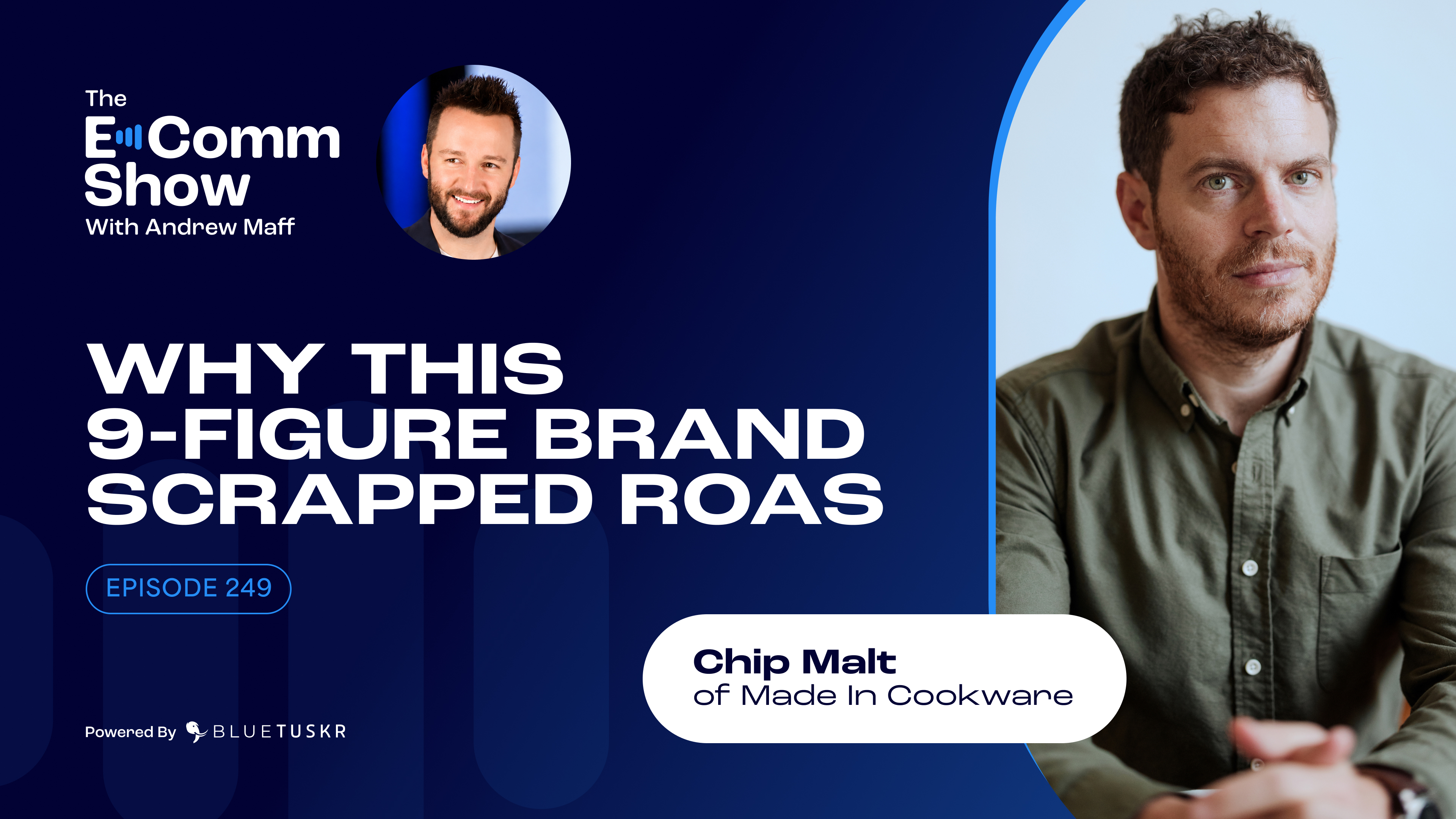
The dashboards all disagree, the platform reps all say spend more, and the customer journey no longer tracks cleanly. Here is how a nine-figure brand measures marketing anyway.
In this 249th episode of The E-Comm Show, host Andrew Maff sits down with Chip Malt, co-founder and CEO of Made In Cookware, the product-first brand used by Michelin-star kitchens and home cooks alike.
Chip breaks down the philosophy that built Made In. You’ll learn why he trusts MER and geo-testing over channel ROAS, how to read the attribution games every platform plays, and why AI is quietly reshaping how customers discover and vet products.
If you are tired of chasing a ROAS that lies, wrangling platform reps, or trying to measure a halo effect you cannot see, this one delivers.
What You'll Learn
-
Product First, Brand Second: Why Made In perfected the product before touching branding, and how affinity drives LTV.
-
Why ROAS Lies: How Chip measures with MER and first-purchase profitability instead of channel ROAS.
-
The Attribution Games Platforms Play: How Google and Meta attribution windows differ, and why overlap inflates your numbers.
-
Handling Platform Reps: Why reps push you to spend, and how their incentives are misaligned with yours.
-
Measuring the Amazon Halo Effect: How geo-testing and lift over baseline reveal what a Meta ad does to Amazon.
-
Marketing in the AI Era: Why AI search is reshaping discovery, and why you cannot track it the old way.
-
Chefs as Customers, Not Endorsers: How authentic, paying users became a defensible marketing moat.
-
Not Chasing Trends: Why Made In holds a performance North Star while competitors chase the zeitgeist.
Watch the full episode below or visit TheEcommShow.com for more.
If you enjoyed the show, please rate, review, and SUBSCRIBE!
Have an e-commerce marketing question you'd like Andrew to cover in an upcoming episode? Email: hello@theecommshow.com
WATCH ON YOUTUBE
ABOUT THE GUEST
Chip Malt
Bradford “Chip” Malt, Co-Founder and CEO of Austin-based cookware brand Made In, was drawn to the industry from an early age, admiring the restaurants and chefs that made his childhood home in Boston so memorable. After starting his own web design company in college, Chip, a business mastermind, moved to NYC to work the trade floor for an investment bank but soon realized his passion toward taking a more entrepreneurial direction with his career.
In 2017, Malt teamed up with his longtime best friend, Jake Kalick, to combine their expertise in business and hospitality to launch Made In. Chip and Jake’s shared passion for premium cookware led the duo to travel the world going everywhere from rural Tennessee, to the picturesque French countryside in search of the world’s most talented artisans to craft their products. Now, Made In products are relied upon by some of the country’s most notable restaurants, purchased by top-tier chefs, and can be found in Michelin-star restaurants Alinea, Le Bernardin, Osteria Mozza, as well as Fairmont Hotels, Wynn Casinos, and many more. Their omni-channel business model allows Made In to provide the most enjoyable and high-quality experience to consumers and chefs alike, where ever they shop.
Episode Transcript
iconChip Malt 00:02
We actually didn't do any of the branding or naming or anything until we felt very good about the product. We wanted to be a product-first company, and there are two reasons for that.
Narrator 00:12
Welcome to the E-comm Show podcast. I am your host Andrew Maff, owner and founder of Bluetuskr. From groundbreaking industry updates to success stories and strategies, get to know the ins and outs of the e-commerce industry from top leaders in the space. Let's get into it!
Andrew Maff 00:27
Hello, everyone. Welcome to another episode of the E-comm Show. As usual, I am your host Andrew Maff, and today I am joined by the amazing Chip Malt, who is the co-founder and CEO over at Made In Cookware. Chip, how you doing, buddy? Ready for a good show?
Chip Malt 00:39
Good. Thank you for having us.
Andrew Maff 00:41
Yeah, no worries. So as we're talking right now, when this goes live, it'll be kind of late October. But as you and I are speaking, we're in the middle of Prime Big Deal Days, or whatever Amazon likes to call that thing now. We'll touch on that. We'll get there. One thing at a time. I like to start these off a little more stereotypically and just give you the floor. Tell us a little bit about your background and how you got started at Made In Cookware.
Chip Malt 01:08
Yeah, probably a weird way of getting into e-commerce in general, but I was computer science trained originally, so I loved the dev world. This was back in 2010-ish when I graduated. I ended up going to Wall Street and hating it. You know, it's almost like the antithesis. Yeah, yeah, exactly. Once being 21 in New York with a paycheck wore off, the glitz and glamour were not there. And it was 2010. Everyone was getting whacked from the global financial crisis, so it wasn't the best culture to be a part of, either. Oh yeah, I remember my first day on the job. One of the bosses walked in and fired an entire floor of people. Everyone got up and walked out together. So that was like, "Welcome to the business world, youngin." I saw the writing on the wall there that I didn't want to be there. I went back to business school and spent most of my time, or half my time actually, doing data science stuff in the information school. That was pre-AI world, but we were still doing neural networks and a lot of marketing science stuff. At the same time, on a positive side, there were a lot of great, smart people on Wall Street who introduced me to a company called Roan Apparel that they had invested in. That was an e-commerce apparel company, and I started freelancing for them for beer money during business school, and then went full time. The cool part about that job was that I was employee number four or five there, and they didn't really have anyone who could model or do anything data-wise. So I took over some demand planning, supply planning, all their IT infrastructure, BI work, data warehousing, and then obviously performance marketing stuff too. I got these demand and supply chops, which was a really great learning experience before going to start my own thing, which we launched in 2017.
Andrew Maff 03:12
That's awesome. So, cookware? How do we get there?
Chip Malt 03:17
Yeah, I get that a lot. I started the company with one of my childhood best friends, Jake Kalik. His family has been doing kitchen supply since 1929, and he runs all physical product and chef relationships and all the stuff he's an expert at. I run all the digital and demand gen and commercials on the front end, and there's some overlap in between. But yeah, I was looking at trying to start my own thing. I love physical product, and I love stuff you can touch and feel, and we love passion categories in general, emotional-attachment categories. When I was looking at the space back in 2016, which is when the idea started to germinate, we couldn't find another category that people were so passionate about that had such low brand affinity. So it's a different challenge. At Roan, we were trying to steal people away from a love of Nike and convince them that our product was better, our brand was better. For us at Made In, the thought was, "Hey, you love doing this. You do it seven, eight, nine, ten times a week, cooking. But you don't wear a T-shirt with any cooking brands on it like you do with Nike, and you don't talk about it in public." How do we make you care about this space in a way that you haven't before? Our angle was, "What do you love about food?" It tends to be very supply chain-heavy. Single-origin coffee from Nicaragua, wine from Burgundy, France, wine from the Malbec regions of Australia, stuff like that. Everything is rooted in maker craft. Steak from a butcher 30 miles outside of Austin, Texas, that's beautifully marbled, like Kobe beef from Kobe, Japan. Everything is rooted in craft, so let's take that same approach and bring it to the kitchen tool space, which really hadn't been done before. If you're going to buy that Kobe beef steak, why don't you care about the pan that you're about to cook it in? Really, because you do the cooking itself. So we started with that approach, which is really makers telling a maker's story. That's where the name Made In comes from. It's all about the makers of the product, and then it grew from there.
Andrew Maff 05:33
Yeah, that's very interesting. I mean, it obviously makes a ton of sense. One thing I was curious about, and was very excited to talk to you about: Made In Cookware is the quintessential example of creating a good product that can build on itself. Obviously, there's great marketing, and there's great messaging. To your point, it's how do I get people to care about kitchen tools just as much as they care about the food they're putting in them? That totally makes sense. But if you had put together a bunch of really bad skillets, no one's going to use them, right? So there still comes the quality of the product. How would you explain how the quality of the product is just as important and helped you scale from there?
Chip Malt 06:19
So we actually didn't start the brand. We didn't do any of the branding or naming or anything until we felt very good about the product. We wanted to be a product-first company, and there are two reasons for that. We were starting the idea, or having the idea, around 2015, 2016, which was the first crop of direct-to-consumer brands coming out, and a lot of them were the opposite of what you said. They would say, "Hey, we hired Red Antler at the time. They made this beautiful brand." The brand, literally the look and feel, was the differentiator to the market, not the product. We had two hypotheses. One was, okay, that was going to be commoditized quickly. Casper came on the back of Allbirds, or Allbirds came on the back of Casper, but they looked and felt the same. So how quickly does that differentiation wear off? And that's not defensible. Anyone with a $200,000 Red Antler check can go create that. Yeah. And then two, this was also the rise of people really going ham on unboxing experiences and things like that, and we asked ourselves about Allbirds. I mean, this was 2016. Remember, Allbirds had this awesome unboxing experience. It was the thing that unrolled, like the roly-poly, and the shoes were in different ones, and it was super unique. But outside of that, we'd go back to our friend groups. We were doing a lot of consumer testing at the time. We'd ask, "Hey, what's something from two months ago that really left an impression on you in unboxing?" And no one would say anything about Apple. So we thought, all right, you can't really fake anything. What products do you love? And people always go back to the product quality. You can't really fake affinity, and affinity drives LTV, and all that matters in e-commerce is LTV. Marketing will fade. No one remembers the TV ad they saw. No one remembers the unboxing experience. They do remember looking at that product three months later and being like, "Man, that product fucking rules." So everything was rooted in the product itself, and then from there we built the brand and the go-to-market strategy, and so on.
Andrew Maff 08:28
Yeah, it makes a ton of sense. I'm sitting here thinking about all the stuff that I have around me right now, and I can't remember what the box it came in was. I have no idea. I could tell you if the product sucks or not right now. Totally. So that makes a lot of sense. Was a lot of that on the front end? Was there a lot of product research and building out in the beginning before you even really started to take it to market?
Chip Malt 08:56
Yeah. One of our competitive advantages was my co-founder Jake's relationships. His family has been selling to the best restaurants in Boston since 1929, right? So every sample we got in, we would just take it down to... I mean, we were 27 at the time, so we'd go to the bar of one of these restaurants, have a beer or two, and give the chefs the pans. Then we'd come back five days later, have another drink at the bar, ask them what they thought, and get their design feedback. That was just on repeat. Every time we got a new iteration of a different metal composition, a different handle, a different style, we were already going to get professional feedback on the product.
Andrew Maff 09:42
So I'm going to use this term extremely loosely, but I'm somewhat familiar with the space, especially compared to you. How do you deal with the ebbs and flows of the trends, like between ceramic and nonstick and then stainless steel? It's up, it's down, everyone wants cleanness, or they want it to not stick. There are 500 different things that people prefer. How do you wade through those waters?
Chip Malt 10:10
Yeah, I mean, it's been tough. In COVID, a lot of, I would say, quote-unquote gimmicky stuff exploded, and it was hard not to chase that trend. You hear through investor universes, "Oh, they're 5xing year over year," and this and that. And you think, "Oh, are we doing that?" It's tough not to let the lemmings sway you a little bit.
Andrew Maff 10:32
Yeah.
Chip Malt 10:33
At the end of the day, our brand stands for everything we make having to stand up to the performance and durability requirements of the world's best kitchens, and there's a lot of stuff out there that does not back that up, and it's hard not to chase it if you're playing the long game. It's interesting because we work with manufacturers who have been doing this for 100 years, 200 years, 300 years, and you ask, "Hey, what do you think about X brand, X product?" And they say, "We see this every decade. A new brand does this. This is not new technology. A new brand comes and goes. It catches a little bit of the zeitgeist, everyone realizes its value props are not what it promised, and three, five years later, it's gone." You see that start to play out in Amazon star reviews and year-over-year comps and things like that. So we've always stayed with that north star of the performance and durability requirements of the world's best kitchens and let that guide the product development process. And I think the tough part right now is actually a consumer problem. PTFE Teflon is a great product. It does not stick, and it is very durable. Ceramic, which we make too, is a fine product. It's not lasting as long as Teflon. It starts just as good, maybe slightly better, but it degrades much, much quicker. And everyone is trying to find what the replacement is for Teflon, and there really isn't something that matches the convenience and product quality of Teflon. So it's causing a lot of chaos in the market, because one, everyone's promising the world to try to steal that consumer away from Teflon, but nothing is actually standing up as well as Teflon. So I think you're seeing this washing machine of consumers bouncing around between different promises. And as the space has gotten more popular, the lawsuits have come into the space as well. The claims that used to go under the radar, like "just throw it in the dishwasher," "bring a knife to it," "it's not toxic," all that stuff is coming under the microscope too. So the space has changed a ton, and we're just not the brand that's chasing the trend.
Narrator 12:59
Is your e-commerce business experiencing falling revenue? Bluetuskr has helped many brands like yours excel. Unlike other marketing partners, Bluetuskr leverages a team of specialists to ensure every strategy is created and executed toward your business growth. As an extension of your marketing team, Bluetuskr prides itself on helping to fill in the gaps and develop strong omni-channel strategies to diversify your business from the rest. Ready to scale your marketing initiatives? Visit their website, Bluetuskr.com. That's B-L-U-E-T-U-S-K-R.com.
Andrew Maff 13:32
At this point, it probably helps that you're a first mover, because the space is obviously way more competitive right now. I would imagine the clout of being able to say, "We're in Michelin-star restaurants, we're in some of the top hotels in the world," going up against competitors' arguments, makes it really tough for them to have a leg to stand on when you literally have the best chefs in the world. Your influencers are also your users, and they love the product and just keep using it over and over again.
Chip Malt 14:07
Correct, and our actual customers... We have a lot of competitor brands that either donate full kitchens or pay to say the same thing, but our whole stance is, sure, you can do that for five, ten, fifteen customers, but maybe you can't do that for 4,000. So we always refer to them as customers. They're using their own dollars to buy from their restaurant or for their project to buy our stuff. They're not endorsements. They're not partners. We believe that's our differentiator. We have agents for chefs reaching out all the time, saying, "So-and-so with 500,000 followers is opening a new restaurant, and we'd love a free kitchen." And it's like, sorry, the authenticity of the brand, that the chefs choose to use and pay for it, is our differentiator.
Andrew Maff 14:58
One of the things I was really excited to ask you about is... On this show, we get a lot of high seven-figure and eight-figure brands. We're not able to bring many nine-figure brands onto the show, so I greatly appreciate your time. One of the things I was very curious about, because it's kind of a hot topic right now, is how you judge the success of your marketing efforts. We have a lot of brands that are still looking at ROAS on individual channels, with the stronger belief being more like MER or CAC to LTV, which in your scenario, I guess, depends on how long your LTV window is. But how do you judge the success of it?
Chip Malt 15:36
Yeah, I mean, it's becoming harder and harder with privacy becoming more and more of an issue, or "issue" is probably not the right connotation, but you know what I mean, more of a pervasive technology thing, as well as the size of your company. For us, to your point, we still have cohorts from 2017 and 2018 that are contributing heavily, and we're not a subscription business, so our LTV is long. When we look at churn, we have to define it differently than probably a lot of brands. All that stuff, your model, I think, is bespoke to you, your company, your product, and your price point. Early in the company, people are always doing 90-day win-back campaigns and this and that, and it's like, well, why did we choose 90? In the first five or ten years, you're thinking, are we reading the data, or did we create the data, right? So there's that dynamic. But for us, we have to be profitable on first purchase, because that window afterward is long. That defines all the metrics we care about.
Chip Malt 16:48
Okay, our contribution margin in the door is X. That means we want to be 10% profitable on first purchase. That means we, as a blended company, have to hit X ROAS or whatever, and that translates to this new ROAS. We always do everything in ROAS, not CAC, because it pushes for AOV as well. And then the question is attribution within the channels, right? We've always said from day one that our whole goal is to try to figure out how the platforms are screwing you. They're all demand.
Andrew Maff 17:21
Good way to learn, right?
Chip Malt 17:22
Right, right. Every single one is trying to capture the most amount of demand into their platform. So one, you have to fully understand attribution windows. An easy example is that Google attributes things back to the click, while Facebook attributes to the day of the conversion, right? That's a massive difference. You could switch off a Facebook campaign today, never spend again, and you'll see conversions hit the dashboard four, five, six days later, whatever your window is, because it's the day of. Whereas with Google, if you switch it off, it's always at the click point. So what does that mean? When you're pulsing ahead of a big sale event or whatever, those things manifest very differently in the platforms. If you don't understand the basics of platform attribution and you're using platform attribution, you're already screwing yourself. How are you going to scale that? And then the question is overlap, right? You sum up all your attribution across all those platforms when you're a nine-figure business, when you're an eight-figure business, right?
Chip Malt 18:22
Totally, totally. And you listen to the reps. I mean, the Google rep flipped out on her. She's like, "We need to be tripling spend because you're missing out. All your budgets are limited," and she says Memorial Day or some huge day. And it's like, no, you guys are just... You know, the Facebook person says the same thing. If we did this across all of them, we're always going to capture the same stuff. So for us, it's all about trying to find incremental reach and incremental audience size, and that gets harder and harder as you scale, because you're way further along the diminishing returns curve when you're an eight-figure business than a seven-figure business, or a nine-figure business. So yeah, our whole game right now is incremental qualified audiences.
Andrew Maff 19:05
Yeah, yeah, I could go on a whole tangent on platform reps. We tell the brands we work with that they're not allowed to get on a call with them without us on it, because they're just going to tell you to spend more.
Chip Malt 19:18
Totally. And new products too. We went to dinner with one the other night, probably a couple of months ago, and I asked, "How are you guys comped?" And they said, "Oh, it's part of how much our people spend on the platform." So yes, they're incentivized to get you to spend more, but also if they launch a new product, there are product adoption kickers. So when there's, you know, PMax or fucking Advantage Plus, or some of this new stuff, it's like, you better give us a massive amount of credits to go test that stuff, because I know you're comped on it. And yeah,
Chip Malt 19:50
I'm not going to be the one... Their incentives are not aligned, for sure.
Andrew Maff 19:56
How do you measure... Because you mentioned you're looking at ROAS company-wide, which is a fantastic way to do that. How do you measure that across channels? Obviously, today being Prime Big Deal Days, or however they call it, I always mess it up, how are you judging halo effect to Amazon? You're running Meta ads, and they bleed over to Amazon. How do you look at all of that holistically?
Chip Malt 20:19
Yeah, I mean, we really use triangulation across a lot of different things. Everyone else is like, "What's your single source of truth?" And it's like, man, we're trying to tell a story on what we believe. I kind of like what's happened in performance marketing, where multi-touch attribution is just smoked, and you actually have to think now.
Andrew Maff 20:41
I agree.
Chip Malt 20:41
It's more fun, at least.
Andrew Maff 20:43
True marketing again!
Chip Malt 20:45
Totally, totally. So we'll do a ton of different things. Obviously, we use geo testing across both channels. We won't launch demand gen, and we'll see what happens to Amazon and whatever, and put an incremental ROAS to that. That's probably the closest to a quote-unquote north star of what we believe. But then we'll do simple correlations. Our Saucier right now is one of our biggest spend items in Meta, and it's not a big spend item in Amazon, but it's our number one seller during this Prime Day, right? So at least that starts this red thread of, okay, something is bleeding over here. We're not going to test a single ad with a geo test in a measured house or anything like that, right? But there's clearly a correlation here. So let's start to look at lifts over baseline. It was selling 10 units a day, and as we've increased spend from $10,000 to $30,000, now we're getting 100 units a day, incremental over baseline. So we do a lot of incremental-over-baseline work around media spend, specifically at certain products or categories, just because we don't trust the journey at all. Especially as you get into TikTok, YouTube, like the map—
Andrew Maff 22:04
Oh yeah.
Chip Malt 22:04
YouTube, who's clicked through a YouTube video to go buy something? You're trying to hijack a journey, so view-through attribution, click-through attribution, it's all a mess. For us, that stuff is geo test or lift over baseline for categories, and so we'll pulse categories hard. Like, "Hey, I want to see what happens to tabletop. Let's go from $2,000 to $20,000 and then just see what happens in Shopify to the tabletop category." Nothing in between. No clicks, no platforms. Just see what happens, and then talk about whether that feels like it's worth it or not, right?
Andrew Maff 22:42
Yeah, we're back to digital getting more traditional again. You're back to just putting it in different channels and...
Chip Malt 22:51
Yeah.
Andrew Maff 22:51
Hoping it works.
Chip Malt 22:53
Yeah, and there's a lot of stuff in between, right? We try to break down the funnel a lot quicker. What privacy stuff and cross-device stuff and IP masking and Private Relay, all this stuff coming, does in our heads is bifurcate the journey. So you're on your mobile at work, and then you're on a different IP at home on a desktop. How do you match that journey? Who cares? But we do know that at least the click to on-site on that same device is measurable. It's in the same session, on the same device, on the same IP. So if you have a lowish or badish CPC Facebook ad that's driving to a page that has a high bounce, there's no way that math ever works, even if the platform's telling you it's a 3x ROAS. That's not going to scale, and that's an automatic shutoff. So we also break things up into easier, quicker journeys that we feel more confident in the data on, and don't try to track the click.
Andrew Maff 23:57
And now, I mean, we could go off on a tangent on this for probably a long time, because now you've even got another channel that throws another wrench into everything. We're seeing brands that increase, let's say, demand ad spend on Meta, TikTok, things like that, and we're seeing increases in AI search queries and revenue coming through AI, because now everyone's learning about stuff, and then they want to ask their personalized AI whether they should buy it. So you can't attribute it, because even AI doesn't know where they came from. At this point, the sooner brands get used to the fact that you just cannot track things like you used to, the better. You have to tell a story. You have to get back to true marketing. We had a good run for 10 or 15 years there. I hope you enjoyed it. Now let's get back to actually connecting with our customers as opposed to just making it such a transaction.
Chip Malt 24:48
Totally, totally. And where does AI fit in the funnel? Is it actually the first touchpoint? We've tested ChatGPT ads, and they were pretty brutal. Yeah, we switched those off. So yeah, I mean, it adds some color around the lines.
Andrew Maff 25:05
Yeah. Oh yeah. Chip, this was great. I really appreciate it. I don't want to take up too much more of your time. I know you're super busy over there. I'd love to give you the floor. Tell everyone where they can find out more about you and more about Made In Cookware.
Chip Malt 25:18
Yeah. So we're in the biggest cooking three months of the year. We've got Thanksgiving coming up. We've got Christmas. Everyone stresses out about hosting, or what they should bring if they're being hosted somewhere. So this is a really important time period for us. It's the time period we love the most, not from an e-commerce and revenue standpoint, but because our brand is the most relevant during this time of year, and we have a ton of awesome products, both launching as well as always existing, for helping you out in this fun holiday period. You can find us at MadeInCookware.com, or Made In Cookware on Amazon, or Crate and Barrel, Williams Sonoma. You can find us in all those locations.
Andrew Maff 26:00
All of the above.
Chip Malt 26:01
Yeah.
Andrew Maff 26:01
Chip, thanks so much, buddy. I appreciate you having me on the show. Everyone who tuned in, thank you as well. Please make sure you do the usual thing: rate, review, subscribe, all that fun stuff on whichever podcast platform you prefer, or head over to theecommshow.com to check out all of our previous episodes. But as usual, thank you all for joining us. See you next time. Have a good one!
Chip Malt 26:17
Thank you.
Narrator 26:20
Thank you for tuning in to the E-comm Show. Head over to ecommshow.com to subscribe on your favorite podcast platform, or on the Bluetuskr YouTube channel. The E-comm Show is brought to you by Bluetuskr, a full-service digital marketing company specifically for e-commerce sellers looking to accelerate their growth. Go to Bluetuskr.com now for more information. Make sure to tune in next week for another amazing episode of the E-comm Show!

CONNECT WITH OUR HOST
AndrewMaff.com | Twitter: @AndrewMaff | LinkedIn: @AndrewMaff
Connect With Us





Recent Post

- Oct 14, 2026
- Author: Andrew Maff
How Comfizz Took Off on Amazon Without Running Ads | EP. #248




Tell us what you think!