


.png)
LISTEN NOW





A 4.9-star rating is not luck. It is the one thing most brands are too busy to do well.
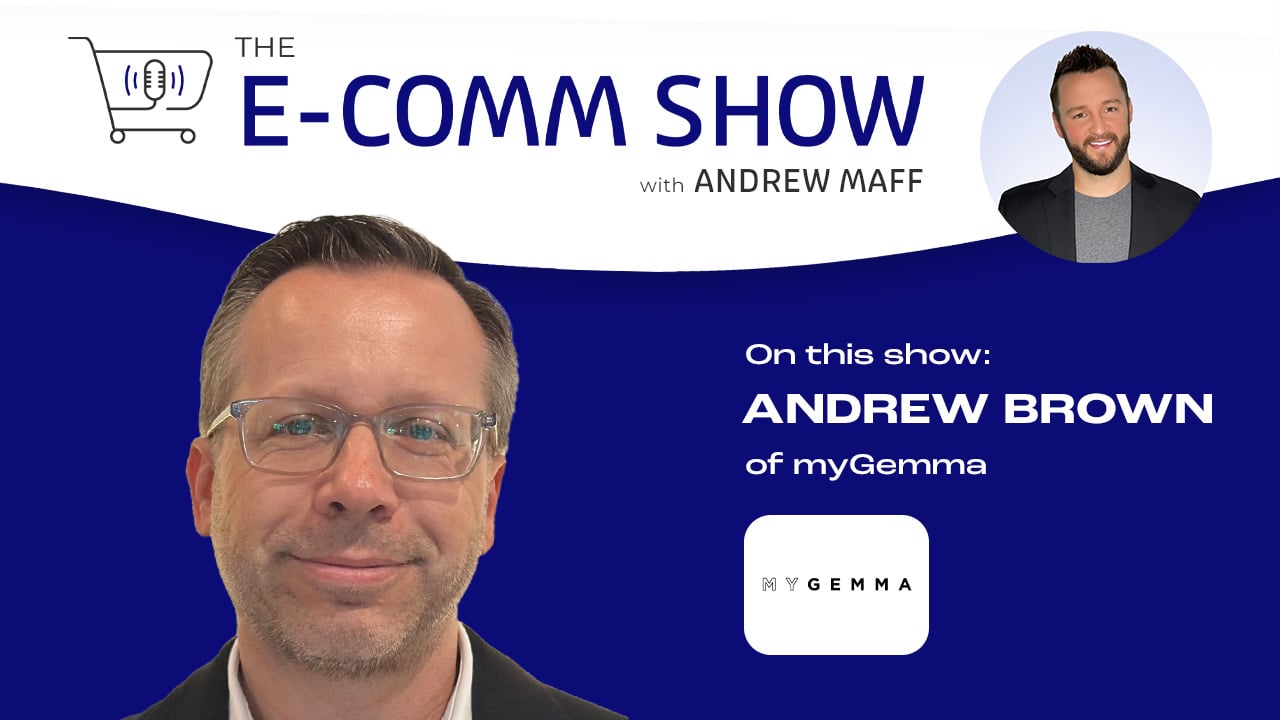
In this 244th episode of The E-Comm Show, host Andrew Maff sits down with Andrew Brown, Founder and CEO of myGemma, the New York luxury reseller of handbags, watches, and fine jewelry from Chanel, Hermès, Cartier, Louis Vuitton, Van Cleef & Arpels, Tiffany, Bvlgari, and more.
He breaks down the chicken-and-egg problem he started with, why inventory and not demand is his real ceiling, and how a 24-hour offer and human customer service earned the best reviews in the category. If you have ever wondered how a resale model actually scales, or what it takes to earn a 4.9 on Trustpilot while buying from the public, this one is worth your time.
What You'll Learn
-
Two Businesses, One Brand: How myGemma buys luxury goods from consumers and sells them back to consumers, and why the overlap between the two groups is still tiny.
-
Solving the Chicken-and-Egg Problem: Why myGemma spent six years only buying products before it ever sold directly.
-
Why Inventory Is the Real Ceiling: How a strong CAC to LTV ratio still cannot outrun a supply constraint, and what that means for spend.
-
The Numbers Behind Luxury Resale: The AOV, CAC, and LTV of a business with a $2,500 average order.
-
Winning on Speed and Service: How a 24-hour offer and human, not AI, communication earned a 4.9 on Trustpilot and 4.8 on Google.
-
Selling Everywhere: Why myGemma runs across 20 to 25 marketplaces, from Amazon Luxury Stores to Bloomingdale's resale.
-
LLMs and Luxury: Where Andrew is already seeing AI-driven discovery, and where agentic checkout still is not realistic.
-
What Keeps Him Up at Night: Managing finite capital and inventory turn in an owned-inventory business.
Watch the full episode below or visit TheEcommShow.com for more.
If you enjoyed the show, please rate, review, and SUBSCRIBE!
Have and e-commerce marketing question you'd like Andrew to cover in an upcoming episode? Email: hello@theecommshow.com
WATCH ON YOUTUBE
ABOUT THE GUEST
Andrew Brown
Andrew is the Founder & CEO of myGemma, a New York based luxury reseller. Focused on handbags and jewelry, myGemma buys and stocks all the biggest brands: Chanel, Hermès, Louis Vuitton, Cartier, Van Cleef & Arpel’s, Tiffany, Bvlgari and more. -Previously, Andrew spent 15 years in the world of finance - with stints in investment banking in London, in equity research at Morgan Stanley in New York, in venture capital and in real estate development. -Andrew holds a bachelors degree in Accounting and Finance, an MBA from the Stern School of Business and an MA in Real Estate Development from NYU.
Episode Transcript
iconAndrew Brown 00:02
We don't respond to them through AI. It's all a human at the end of the phone. It's an email generated by a human, etc. etc.
Narrator 00:11
Welcome to the E-comm Show podcast. I am your host, Andrew Maff, owner and founder of Bluetuskr. From groundbreaking industry updates to success stories and strategies, get to know the ins and outs of the e-commerce industry from top leaders in the space. Let's get into it!
Andrew Maff 00:25
Hello, everyone. Welcome to another episode of the E-comm Show. As usual, I am your host Andrew Maff, and today I'm joined by another Andrew — Andrew Brown, founder and CEO over at myGemma. Andrew, how are you doing, buddy? Ready for a good show?
Andrew Brown 00:25
I'm great, thanks, Andrew. How are you?
Andrew Maff 00:36
Doing all right, not too bad. Super excited to talk to you — this is very interesting. We get a lot of conversations with more traditional, straightforward e-commerce — "I manufacture products, sell them online," etc. You've got more of a resale element to you, the buy-and-trade side, so it's obviously a bit of a different beast, which I'm excited to get into because I've already got a dozen questions. But I usually like to start these off pretty typically — I'll give you the floor. Tell us a little about your background, how you got started at myGemma, and we'll take it from there.
Andrew Brown 01:12
Yeah, thank you. We're definitely a little different. I listen to a lot of podcasts — yours, Operators, and things like that — and 99.9% of the things they talk about are solutions that just don't work for us.
Andrew Maff 01:29
Yeah.
Andrew Brown 01:30
Background: I'm a finance guy by trade and education. I was an investment banker in London in the '90s, then moved to New York for business school. I was an equity analyst at Morgan Stanley during the dot-com craze and bubble, then did venture capital and real estate development. Then, in 2009, 2010, a friend of mine who was in the diamond business pitched me on the idea for basically what became the precursor to myGemma. We built a team and went around to pawnbrokers and retail jewelers, buying scrap gold and diamonds — any kind of scrap they were buying from the public. After doing that for a couple of years, we built a nice business.
Andrew Brown 02:17
I came up with the idea of starting a website to really disintermediate those suppliers and go direct to the consumer — not just to buy the scrap they were selling, but to buy watches, branded jewelry, engagement rings, sneakers, handbags, everything. That eventually morphed into what is now myGemma.
Andrew Maff 02:37
Interesting. One of the very first things I want to talk about — let's start from the beginning, from when you first started myGemma. It's 100% a chicken-and-egg problem, right? You need the product to sell, but you're also buying the product, so no one's coming to the site yet. In the beginning stages, what was your approach to getting over that hurdle?
Andrew Brown 03:01
Well, the solution was that we didn't really have an e-comm site — we were buying all of the product, and whatever we bought, we sold back into, essentially, retail jewelers. We went on eBay, Vestiaire Collective, 1stDibs. This was 12, 13, 14 years ago.
Andrew Brown 03:23
So that was before myGemma became an e-commerce platform. The website originally only did buying. We did that for six years — we bought the product — and it was only around 2016, 2017 when it frankly just got embarrassing. I'd have friends say, "I want to buy a Patek, where do I get one?" And I'm like, "well, I can send you to my eBay store," or — no, let's build a nice website so we can actually sell these things under our own brand, rather than through eBay or Vestiaire or 1stDibs or wherever we were selling at the time. That was kind of the aha moment — all right, it's time we had our own brand and website.
Andrew Maff 04:14
Gotcha. Okay, so when you did that, was it still called myGemma at that point? How were you able to get the audience to understand, hey, you can buy from us now too?
Andrew Brown 04:25
Yeah, for a few years we still had the two websites. The original website was called WP Diamonds, because it had originally started buying diamonds and we just never changed the name. We ran that concurrently with the myGemma e-comm platform for probably about three years before we merged the two together.
Andrew Maff 04:51
Gotcha. So you're really running two businesses here, right — you buy luxury items from consumers, but you're also selling to them. I always end up pivoting to the marketing side of things, I apologize, I'll get into non-marketing stuff too. But from your marketing efforts, how do you decide whether you're promoting "hey, we buy product" or "we sell product"? Do certain channels lean one direction, or is it more general messaging across all of it?
Andrew Brown 05:26
I'd say nowadays it's more general messaging, and we try to hit both elements, but most of our marketing these days is sell-side. We get phenomenal deal flow, transaction flow, and lead flow organically for buying — we rank extremely well on Google, and I think we're starting to do pretty well on the LLMs too. So we get hundreds of leads every day from consumers looking to sell us product, and we don't need to spend a lot of time or money marketing that side of the service. So it really becomes a case of focusing our marketing efforts and spend on the sell side.
Andrew Maff 06:13
Makes sense — you've got a lower barrier to entry with someone who's looking to sell something, and then they realize, oh, I can also buy from them, so it becomes more of a secondary thing. You brought up LLMs, which, I don't think I'm allowed to have a podcast anymore without talking about that. Are you starting to see more organic revenue — I guess we'll still call it organic revenue — coming out of LLMs, on top of what you used to generate from organic search?
Andrew Brown 06:46
Yeah, for sure. A lot of it's kind of anecdotal — customers will say, "oh, ChatGPT sent me here," that kind of thing. We're trying to stay relatively active on Reddit and other forums to make sure our name is front and center. So I think we're doing a relatively good job.
Narrator 07:11
Is your e-commerce business experiencing falling revenue? Bluetuskr has helped many brands like yours excel. Unlike other marketing partners, Bluetuskr leverages a team of specialists to ensure every strategy is created and executed toward your business growth. As an extension of your marketing team, Bluetuskr prides itself on helping to fill in the gaps and develop strong omni-channel strategies to diversify your business from the rest. Ready to scale your marketing initiatives? Visit their website, Bluetuskr.com. That's B-L-U-E-T-U-S-K-R.com.
Andrew Maff 07:44
What's the main marketing channel that a majority of the business is coming from? Is it organic, or is it more—
Andrew Brown 07:49
Oh, it's absolutely organic search — yeah, absolutely organic. And then we do a lot on Google.
Andrew Maff 07:56
So it's mostly people thinking, "I want to sell this," and coming across you for that. From a finance background, that becomes really interesting — figuring out the math of what the LTV is for a customer based on how much they're willing to sell to you, versus a customer who's willing to buy from you. How do you measure that from a marketing perspective, knowing the first thing they'll likely do is come to the website looking to sell something, but then you also have to factor in the LTV of what you might eventually be able to sell them down the line?
Andrew Brown 08:37
Interestingly, even now — what are we, eight years in? — the overlap between buyers and sellers is still relatively small. More than 50% of our supply comes from repeat customers coming back month after month, quarter after quarter. A third-plus of our buyers are repeat buyers on myGemma.com, but the overlap between those two groups — buyers and sellers — is still in the single digits. So there's a ton of room for us to improve there. And from an LTV perspective, our LTV on an overall customer is well over 10 grand. Our AOV is $2,500, LTV is well over $10,000, and our CAC is $250 to $300. So, in my opinion, we could massively increase our marketing spend and continue to significantly grow the customer base.
Andrew Maff 09:51
Yeah. So what's keeping you from doing that?
Andrew Brown 09:56
Capital, inventory — gosh, my lights just went out. We obviously have a certain amount of capital, a certain amount of inventory, and we're turning through 30 to 40% of the inventory some months. So I think at some point there's a ceiling on how much marketing we can push through this kind of engine, if we're already hitting that level of inventory sell-through each month. There's a certain cap, right — we're not going to be able to sell 80% of the inventory in one month, because we're just not going to have the pieces that certain people want. So we'll spend marketing on, say, Cartier or LV, whatever the product is, and we'll attract LV buyers, but we're just not going to have enough inventory for them. It's an art, not a science — that fine balance. I'm sure somebody's going to hear this and say, "oh, AI can solve that for you." And, I mean, I'm all ears.
Andrew Maff 11:11
Well, I don't want to say the word "traditional" e-commerce, but a standard e-commerce business manufactures its own products, so if they had the ability to just pour gas on the whole business because their CAC-to-LTV ratio is so good, they'd simply order more inventory. But in your scenario, you can't order more inventory — you have to have more people interested in selling to you.
Andrew Brown 11:35
Exactly. So we're constantly buying more and more, and that's also capped by capital. We have finite capital, so we buy as much as we can each month, but we don't buy everything we're offered, because — A, we can't afford to, and B, that's what then enables us to keep buying.
Andrew Maff 11:58
I'm curious — I know you come mostly from a financial background, but there's always that broader economic side too. I find this business very interesting, and you've been at it for a while. Are you able to evaluate things like, "hey, we're seeing more sellers right now because of the way the market is," or "hey, I'm seeing a lot more buyers right now because the economy's doing so well"? Are you able to make judgment calls on things like that and forecast accordingly?
Andrew Brown 12:29
Yeah, to a certain degree. I'd say we always have a lot of — sorry, a lot of sellers. We're always inundated with product, more than we want, across tons of brands and price points that we just don't want to spend the money on at any given time. From a buyer perspective, it's incredible the swings you see in volume from one day to the next. January through May was just tremendous volume, day in, day out — didn't stop. Buyers, buyers, buyers. Then June through July 25th was a marked decrease from those prior five months, and then the last five or six days of July through now, it's been insane again.
Andrew Brown 13:27
It was like America went on vacation for seven weeks — June through most of July — and then I guess they came back to get the kids ready for school and started buying again. It just flipped on overnight, late July. And that's with no change to our marketing — we didn't change it in any way during that period, we just kept it flowing as it was.
Andrew Maff 13:53
And I'd imagine, from a buyer side, you're probably anticipating Q4 to be insane — probably peak, like everyone else, right?
Andrew Brown 14:00
Yeah.
Andrew Maff 14:01
Interesting. With your scenario — obviously we do a bunch of research before every episode — one of the things I saw was your Trustpilot rating is like a 4.8 or 4.9, and I think Google was 4.8 or 4.9 too. Your reviews outside of your own website are pretty astounding, especially considering you're buying product from the average consumer, which can sometimes come with, "hey, I don't like the price I got," or "why didn't you want to buy this from me," that type of thing.
Andrew Brown 14:35
Oh yeah.
Andrew Maff 14:35
And then you're selling very high-end product back to other consumers, who also want to be treated a very specific way when they're buying certain types of products. So as we get into Q4, I've had this theory for a while now that the amount of revenue brands are going to see coming out of LLMs is going to jump, simply because the average consumer has gotten more used to using AI to shop, and the conversion rate out of those platforms is obscene. Are you anticipating something similar on your end? Are you thinking, "hey, because we've got all these reviews and we're mentioned everywhere, and we've got such positive results, these LLMs are going to start mentioning us more as people ask more and more questions," and expecting that to start driving a lot of traffic your way?
Andrew Brown 15:27
I think it's certainly going to help. I don't think we're at the point where this talk of agentic commerce is going to lead to people checking out for a $30,000 Birkin bag on myGemma.com.
Andrew Brown 15:42
Is it possibly ever going to happen? Maybe. I'm sure somebody will do it at some point. But look, I think it's all incremental. Is it going to be 50% of our Q4 business? No.
Andrew Brown 15:54
But will it be material? Hopefully. I think we're getting good mentions — as you said, our Trustpilot is the best in the industry, and we really focus on that. The reason it's so good is because we really focus on customer service. We want to make it the best experience someone can have reselling an item and buying an item at resale. So we hold people's hand through the process — we're at the end of the phone if you need us, we're very responsive on email, and we do what we say we're going to do every time. People like that. People like the communication, the efficiency, and the white-glove customer service approach we take, and we don't respond to them through AI — it's all a human at the end of the phone, an email generated by a human, etc. People like that. And if you're buying a $2,000 Louis Vuitton piece, a $500 Tiffany piece, or a $10,000 Cartier piece, I think people still expect that from luxury.
Andrew Maff 17:02
Your insurance has got to be wild, having all that pretty high-cost inventory sitting around — across different warehouses or wherever. How do you handle that? Is it all in one place?
Andrew Brown 17:17
Yeah, it's all here — that's the beauty of an online business. Everything is in our New York City office. We ship from here, all the orders come in here, we ship from here. So we're multi— sorry, omni-channel, but we don't have a physical store. We have a showroom in our office, but not a store somewhere else, or stores in eight cities, or whatever. So all of the product is centralized, we fully control it, it's nice and secure, and then we can ship it out. If somebody places an order at noon, it typically ships out that day, and depending on the value, they can receive it the next day. People love that.
Andrew Maff 17:57
Are you selling on any other online channels? I know you mentioned some retail.
Andrew Brown 18:01
This is one of our differentiators. As I said, we started selling on eBay, Vestiaire Collective, and 1stDibs, and we've continued to build out that roster even as we've focused on building myGemma.com. We're now on 20 to 25 different marketplaces. We were the launch partner on Amazon Luxury Stores for secondhand watches and jewelry. We were the launch partner with Bloomingdale's for resale. We're also on Macy's. We work with tons of others — Rilla Laguilt, etc.
Andrew Maff 18:25
Yeah, and is that all resale items, or is some of that stuff you're buying more in bulk?
Andrew Brown 18:45
No, no — everything we do is resale. We buy it all as onesies from consumers.
Andrew Maff 18:51
Yeah, interesting. So what are you struggling with right now — what's the thing that's keeping you up at night? We always have these conversations, and I always find it interesting to ask, because it's always, "oh, we do this so well, we do that so well," but we all get it — there's always something. What's eating at you?
Andrew Brown 19:08
It's really managing finite capital — making sure we're buying as much as we can each month without overspending and running out of cash. I'd say that's the biggest struggle. It's juggling the inventory, because while we do have a consignment business, only a third of what we have is consigned, so two-thirds is owned. So we have millions of dollars of owned inventory, and while I want to keep building that, obviously that's a cash drain. So it's really just managing that inventory turn, the purchasing, etc. We can't turn around to our supplier in Hong Kong or Japan or wherever and say, "all right, I want 1,000 units of that" — we just don't do that. We turn to our consumers and say, "yes, I'll buy that, and that, and that," and they ship them in. It's a daily process — we have a team on the phone all day with customers, offering on this, offering on that, closing those deals and getting them shipped in.
Andrew Maff 20:20
Yeah. So really the only way to pour gas on it is to increase the marketing efforts, or the outreach to people looking to sell these products, so you have the inventory you can then turn around and resell.
Andrew Brown 20:32
Yeah.
Andrew Maff 20:34
So do you look at investment or a loan, anything like that, to help speed those efforts up, or right now are you more in a "let's keep it as is" mode?
Andrew Brown 20:44
Yeah, no — we have a credit facility, for example, so we tap that. But it's all still a juggling act.
Andrew Maff 20:56
Yeah, isn't it always. Interesting, Andrew, this was great — I really appreciate your time today. This was super interesting; it's always fun to hear about different business models in the e-commerce world and how everyone's juggling things. I'd love to give you the floor — tell everyone where they can find out more about you and, of course, more about myGemma.
Andrew Brown 21:17
Thank you. Yeah, myGemma.com — M-Y-G-E-M-M-A.com. Check it out. If you have any questions, by all means, email me: andrew@mygemma.com.
Andrew Maff 21:31
Beautiful. Thank you, sir, thank you so much, appreciate you being on. Everyone who tuned in, same thing — do the whole normal stuff: rate, review, subscribe, all that fun stuff, whichever podcast platform you prefer, or head over to theecommshow.com to check out all of our previous episodes. As usual, thank you all for joining us. See you next time. Have a good one!
Narrator 21:48
Thank you for tuning in to the E-comm Show. Head over to theecommshow.com to subscribe on your favorite podcast platform, or on the Bluetuskr YouTube channel. The E-comm Show is brought to you by Bluetuskr, a full-service digital marketing company specifically for e-commerce sellers looking to accelerate their growth. Go to Bluetuskr.com now for more information. Make sure to tune in next week for another amazing episode of the E-comm Show!
.jpg)
CONNECT WITH OUR HOST
AndrewMaff.com | Twitter: @AndrewMaff | LinkedIn: @AndrewMaff
Connect With Us





Recent Post
- Sep 16, 2026
- Author: Andrew Maff
How myGemma Built a Two-Sided Luxury Resale Brand | EP. #244

-2.jpg)
- Sep 09, 2026
- Author: Andrew Maff
The Q4 ROAS Myth: Why Return on Ad Spend Is the Wrong Q4 KPI | EP. #243





Tell us what you think!