


.png)
LISTEN NOW





Most Amazon sellers think brand protection starts when someone copies their product…by then, it’s usually too late.
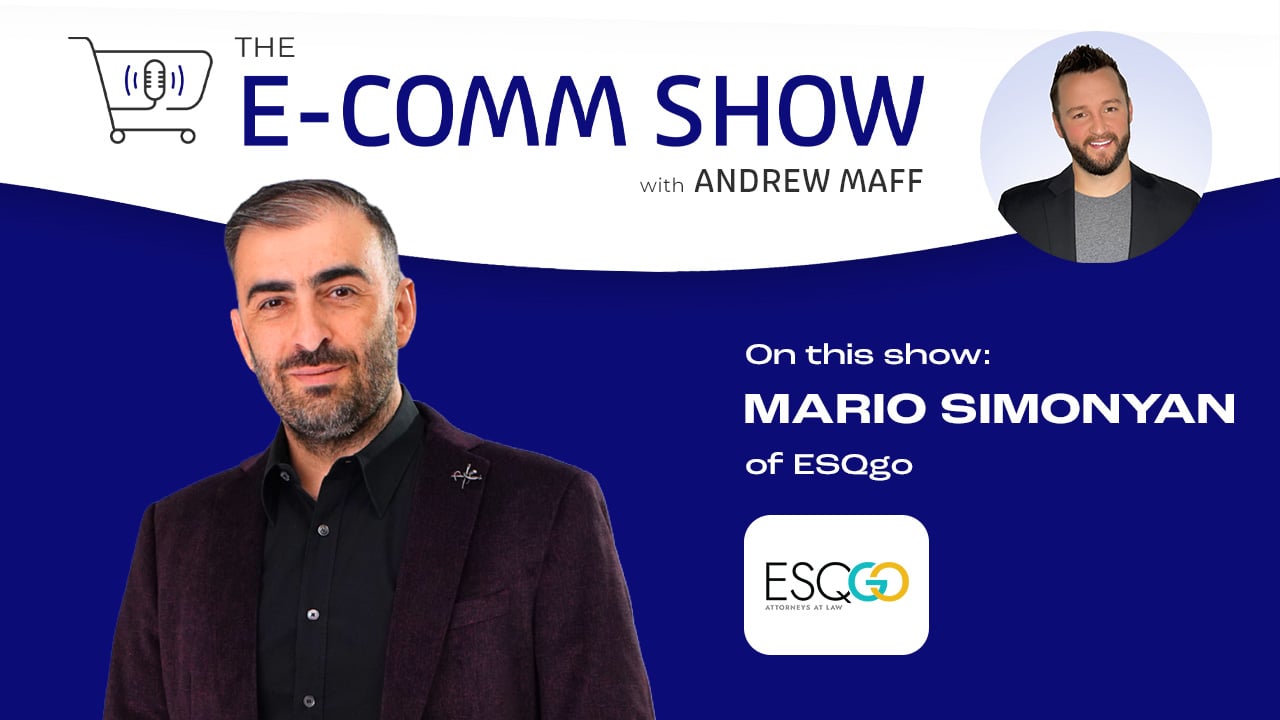
In this 234th episode of The E-Comm Show, host Andrew Maff sits down with Mario Simonyan, Founder of ESQgo, to discuss one of the biggest threats facing growing e-commerce brands: unauthorized sellers, copycats, and intellectual property infringement.
As a former Amazon seller turned attorney, Mario brings a unique perspective from both sides of the industry. From rogue resellers and counterfeit products to the legal strategies brands can use to regain control of their listings, this episode offers a behind-the-scenes look at what actually works when brand protection becomes a business-critical issue.
If you've ever dealt with hijackers, unauthorized sellers, MAP violations, or copycat competitors, this episode could save you a significant amount of revenue and frustration.
This episode is sponsored by ESQgo, the e-commerce law firm helping brands fight back against copycats, rogue resellers, and marketplace headaches. From Amazon arbitration to brand enforcement, ESQgo gives sellers the legal expertise they need to protect revenue, preserve brand value, and stay one step ahead of bad actors.
What You’ll Learn:
-
The Biggest Brand Protection Threats on Amazon: Why unauthorized sellers and copycat competitors are creating major problems for established e-commerce brands.
-
Why Traditional Brand Enforcement Often Fails: The three-part approach Mario uses to remove bad actors using intellectual property, marketplace policies, and regulatory compliance.
-
How Brands Are Losing Revenue Without Realizing It: Why many sellers underestimate the financial impact of unauthorized resellers and marketplace leakage.
-
What to Do Before You Have a Problem: Why trademarks, copyrights, patents, and proactive monitoring are essential for protecting long-term brand value.
-
The Truth About Amazon Arbitration: When it makes sense to fight Amazon legally, and when sellers should handle issues themselves.
-
How Amazon Is Changing Its Approach to Sellers: Why Amazon continues shifting away from reseller-focused businesses and increasingly favors brands with strong intellectual property protections.
-
Real Brand Protection Success Stories: How brands recovered hundreds of thousands of dollars in lost revenue by removing infringers and unauthorized sellers from major marketplaces.
-
How AI Is Changing Brand Enforcement: Why bad actors are becoming more sophisticated and what brands need to know about protecting their content in an AI-driven world.
Watch the full episode below or visit TheEcommShow.com for more.
If you enjoyed the show, please rate, review, and SUBSCRIBE!
Have and e-commerce marketing question you'd like Andrew to cover in an upcoming episode? Email: hello@theecommshow.com
Sponsored by:
.png?width=265&height=97&name=ESQ-logo-RGB-transparent%20(1).png)
WATCH ON YOUTUBE
ABOUT THE GUEST
Mario Simonyan
Mario Simonyan is the Founder of ESQgo, a law firm focused on helping established ecommerce and Amazon brands protect their revenue, reputation, and brand control as they scale. He works closely with 6–7‑figure brands dealing with unauthorized sellers, listing hijackers, and brand misuse—issues that quietly erode recurring revenue month over month. Mario’s work sits at the intersection of ecommerce operations and legal strategy, combining deep knowledge of marketplace dynamics with intellectual property and enforcement frameworks. His focus is not just stopping problems after they escalate, but helping brands identify and recover ongoing revenue loss and put systems in place to retain that value long term.
Episode Transcript
iconMario Simonyan 00:02
When the time comes for brand enforcement or arbitration, that's when you really need an attorney.
Narrator 00:09
Welcome to the Ecomm Show podcast. I am your host, Andrew Maff, owner and founder of BlueTuskr. From groundbreaking industry updates to success stories and strategies, get to know the ins and outs of the e-commerce industry from top leaders in the space. Let's get into it!
Andrew Maff 00:24
Hello, everyone. Welcome to another episode of The Ecomm Show! As usual, I'm your host, Andrew Maff, and today I am joined by Mario Simonyan, who is the founding attorney over at ESQgo, Mario, how you doing, buddy? Ready for a good show?
Mario Simonyan 00:37
I'm doing well. Definitely ready. Beautiful, thanks for having me on.
Andrew Maff 00:41
I'm super excited to have you on. The, you know, it's always kind of interesting the feedback we get when it's like, oh, it's an attorney, because, like, attorneys, we all know, like, I'm an agency, we have a negative connotation, so do attorneys, so we have that same feel, but I always love these conversations because there are so many things that sellers think because they feel it should be a certain way, and nine times out of 10 that ends up being inaccurate. And then we get to sit down and speak with someone like yourself, who actually knows this stuff inside and out. So, I'm super excited to have you on the show. I always like starting these off pretty stereotypically, just for the most part, so everyone kind of gets a lay of the land. Can you just tell us a little bit about your background, how you got started at ESQgo, and we'll take it from there.
Mario Simonyan 01:24
Sure, so I came into the space from the operator side in law school in my second year of law school, I started an Amazon PL brand. Daniel Moran, if you know who he is, back then he had YouTube videos, so I came across one of his YouTube videos. I was like, oh, this is interesting, and even as a kid, like, I always enjoy the importing. Something about that was fascinating. So, when I came across his videos, I was like, I could do this. So, while all my other classmates were going and getting internships and sort of jobs at law firms, I was like, I'm going to start my own brand, and I started a kitchenware sort of home goods brand, started bringing in products from China, private labeling, and that's how I got into the Amazon space. Fast forward, maybe six seven years, I was like, I'm tired of selling kitchen knives and tea kettles and cutting boards, you know. And at the time, I'd already passed the bar, so I was like, "I'm attorney, what should I do? And I was like, "Okay, I'm at the intersection of sort of the law and Amazon, so in 2018 is when we started ESQgo, our law firm, and for the past we just celebrated actually our eighth year, june 1 is when I started in 2018 so two days ago we celebrate our eighth year, so definitely big accomplishment, but for the past eight years, Andrew, all we've been doing is representing ecom brands. When I say ecom brands, obviously most of that is with Amazon, but we've seen everything from helping clients, our Amazon sellers slash clients with ACE and reinstatement all the way to arbitration with Amazon, we've got about a dozen cases with currently pending with Amazon in arbitration before the AAA, so we've seen everything, and our real focus has shifted to brand enforcement, take removing infringers, removing unauthorized sellers, so that's that's what our bread and butter has been, and that's really where our focus is. And if you want, we can also get into some war stories.
Andrew Maff 03:29
Oh, I love war stories. Oh, we got to do some war stories. One of the things.. the first thing I thought about.. I've been told this in the past, and I don't know if it's true or not, but when you're dealing with pretty much everything you just listed, account suspension, Ace, and reinstatement, that type of stuff, that it is not necessary to have a lawyer involved. Well, obviously you're going to be a little biased into this, but what's the tell me, like, what's the thought around that? Is there any truth around that, or what?
Mario Simonyan 04:01
You actually, you'd be surprised. So, keep in mind, I consider myself a business owner first, and then an attorney second. So, I've even told my clients, if this is an issue that you feel comfortable resolving, and I'm okay providing some guidance, go ahead and do it yourself. We attorneys should be used as someone that provides guidance, but also sort of a last resort, because if we're just talking about drafting POAs, plan of action or appeals, fine, if you think if you've done it before, do it yourself, but when it time, when the time comes for brand enforcement or arbitration, that's when you really need an attorney, like I don't suggest anyone goes to arbitration without an attorney, right, if you're drafting a POA, fine, go ahead and do it, but even on the brand enforcement side, like clients will usually try to do it themselves. Some of our larger clients have teams, internal teams that take care of brand enforcement, but they're, you know, there comes a time where they're like, okay, we've tried everything, but we can't get rid of these 20 or so resellers or infringers, that's when we'll step in, and that's when they'll contact us. So that's how I see attorneys being used.
Andrew Maff 05:10
What tends to be like the biggest problem now, is it listing hijackers, brand enforcement, IP infringement, which I'm guessing is effectively the same thing, or account reinstatement, suspensions. Like, what do you kind of see, and is like the big this is always a problem, right now.
Mario Simonyan 05:25
So, with the clients that we have, our clients usually fall into the space of having their actual brands having intellectual property, and their revenue range would be from 2 million all the way up to 100 million, but the problems that they face is less about ASIN suspensions and account suspensions, it's more about I've got these rogue resellers on here, and I don't know where they're getting my products from, and I don't know how to get rid of them, or I've done so well, my product is so popular, my brand is so popular, now I've got copycats coming in, right, so those are those are sort of the two areas that we see the most issues with brands that size is with unauthorized resellers, which we have sort of in one category, and then IP infringers, which are going to be your copycats.
Andrew Maff 06:10
Yeah, the copycat side, like I know, like from our end, obviously, in the marketing world it's a big conversation as well, because especially in the Amazon space, the constant complaint is, you know, people coming from overseas knocking off products and selling cheap versions of them. How do you deal with that? Because I know that there's some type of laws around, like where they're located versus where you're located, plus Amazon's the middleman. Like, how does that get addressed?
Mario Simonyan 06:37
Yeah, so most companies, most agencies, even litigation firms, because it seems like those are the two options for brands. They'll only look at IP, so Andrew, they'll look at and say, okay, is this copycat infringing your copy, your copyright, meaning like your product images, and sometimes it's a no, right? If it's a yes, it's a, it's an easier question to answer, but sometimes it's a no, so you have to look at other things, but the way we developed our brand enforcement is we look at three three different pillars, not just intellectual property, but we also want to look at marketplace policies, because a bad actor may not be violating or infringing your IP, but they may be violating Amazon's own policies, or Walmarts or TikToks, right. And then the third pillar is regular regulatory compliance.
Mario Simonyan 07:25
So there was a large brand that we were helping, and we found out that their products were being imported from Germany into the US. Now the US has certain rules, especially here in California, where there's certain warnings you need to place on products if they meet that criteria. Here in California, it's the Prop 65 which is pretty prominent, and if you're bringing products from Germany, there's no way that those products over there are going to have that warning. So that's what we use, is that third pillar, the regulatory compliance to knock off these unauthorized, these bad actors, right, but unless your brand, your brand enforcement agencies using all three pillars, it's not going to be a great result. And we see a lot of clients that come to us after they've been to a brand agents of brand marketing, sorry, brand enforcement agency come to us and say those people, it's kind of shallow because all they're going to be doing is filing copyright complaints or trademark complaints. I need something a little bit more comprehensive, so that's on the infringement side. And then on the unauthorized side, we use the same three pillars, right? On the unauthorized side, Andrew, I think what Amazon has done, and I've said this in different places too, is I do think that Amazon is going away from the resellers and wholesalers and focusing more on brands, the policy that they came up with. Again, I say latest, and obviously that's a bit relative, but with the counterfeit policy, so if we could get Amazon to sort of acknowledge that hey, our client never sold this product to this bad actor, and we have no idea where they're getting it from. Go ahead and ask for their supply chain, that's one easy way to get them removed too. Because most likely you're not going to be able to provide the full supply chain.
Narrator 09:11
Is your ecommerce business experiencing falling revenue? Bluetuskr has helped many brands like yours excel. Unlike other marketing partners, Bluetuskr leverages a team of specialists to ensure every strategy is created and executed toward your business growth. As an extension of your marketing team, Bluetuskr prides itself on helping to fill in the gaps and develop strong omni-channel strategies to diversify your business from the rest. Ready to scale your marketing initiatives? Visit their website, bluetuskr.com that's B L U E T U S K r.com r.com
Andrew Maff 09:44
I went to.. I'm not going to say the name, because I don't want to.. I don't want to talk ill of them, but I went to a conference last year. It was very focused on the resellers and the wholesalers. That might have been the most depressing conference I had ever been. So everyone was like Amazon doesn't really like us anymore. We keep getting flagged for this and that, blah blah, and like it's just.. it's so painfully true that Amazon seems to really not want to be working in that direction anymore. Very interesting. What's the..
Mario Simonyan 10:17
yeah, and sorry, just really quick, too. And keep in mind, Amazon sets the tone for other marketplaces too. Walmart is following Sue and doing the same thing, right? TikTok, maybe not yet, but I can foresee the same thing happening there with TikTok.
Andrew Maff 10:33
How much do you work with Walmart?
Mario Simonyan 10:35
Well, the major marketplaces, when clients come to us, like I'm a fan of focusing on where we can really deliver an ROI, so the largest marketplace is going to be Amazon, and then Walmart, and then TikTok after that. So it's like those are three marketplaces where it's like, if we could protect the brand and not have infringes or unauthorized resellers there, that's probably 90% of the revenue for our clients, right? But once we remove them from Amazon, it's not like they magically disappear, Andrew. Guess where they're going? Probably to Walmart, right? Because if they got inventory, they're not going to just throw it away.
Andrew Maff 11:08
Good point. Yeah, so I know that most of the people that probably reach out to you, it's a in a reactive way, which, not to take any business out of your plate, but if you were to suggest, what can they do? Like, is there anything you can do proactively, or is this just like, hey, this is a cost of doing business, you're going to have to deal with people ripping you off every now and then.
Mario Simonyan 11:29
No. Number one, as far as being proactive, make sure you've got your IP, so if you, the trademarks, copyrights, and any patents that you can get, make sure you get those, because that sets the groundwork for everything else. Number two is just being proactive and knowing it's like if you are leaking revenue to infringers or unauthorized resellers, have an idea of where they are, what marketplaces they're on, and also an idea of how much money you're losing, right? Because if you're only losing, for example, $100 a month, it doesn't make sense to hire someone like us. We've had clients that were losing 200k a month. Now that does make sense, right? And again, we could, we could get into some of these stories.
Andrew Maff 12:09
I was just going to say that's a good segue. Mario, give me a war story. What do you got?
Mario Simonyan 12:13
Yeah, so we had was in the supplement space. Seems like most of the copycats and unauthorized sellers, they target supplement brands, and then beauty and cosmetic, right? So those are the two just so happens more competitive product categories. So we had a client come to us who had used a brand enforcement agency, and I think they did an okay job. They removed some of the infringers, but the one that was really important to our client, that was costing them a lot of money, they were unable to remove, and they were on TikTok, and our client came to us and said, "This is what the other team has done, now I need something a little bit more serious. We stepped in, and within three months, we were able to remove multiple infringers from TikTok, so we removed them, and that equated to about $200,000 in sales revenue that the client was now able to recoup. Now, obviously, he's not going to be able to recoup all of it, but even if it's half of it, that's still 100k to his bottom line, right?
Andrew Maff 13:15
Yeah.
Mario Simonyan 13:16
So again, great result there, and that was a supplement brand. The other story we had, which is a bit heartbreaking, is a client came to us. They've got a big presence on Walmart on their own website. They're in a lot of brick and mortar stores, and they said that they left Amazon, and my thing was, why, right? Because it's no longer a choice of whether the brand wants to be on Amazon, because even if the brand doesn't, other resellers will find their products and now on Amazon, right? So, but they said that they left Amazon because they couldn't control their rogue sellers, those were their words, meaning unauthorized sellers. And my thing was, what do you mean? Like, well, we have no idea where they're getting it from. We do ship to Africa, and we think that it's somehow those products that inventory never gets to Africa, but it's staying here in the US and just being diverted back into the e-comm channels. So we took a look, and we're like, you're losing about a 1.5 million a year in sales revenue from Amazon, because that's what the other unauthorized resellers were doing, and of course, their map pricing was all over the place, and all that, but we were within about four to five months, we were able to remove about 90% of those unauthorized resellers off of Amazon, so it's like, obviously, the client's happy, and think about what that does for the client's business itself, as far as valuation, if you add, even if it's a million dollars, if you're selling at an 8x multiple, which is what brands that at that level of being established would go for. That's about $8 million in revenue, or I should say, value that you add to the interface. So it's like I love stories like that, and I love talking to them afterwards, like I tried everything else I didn't know this was possible, you know. It's like stories like that.
Andrew Maff 15:03
Yeah, that's awesome. Is there anything that happens for them to like recoup losses, or is it really just like really all you can do is take them down?
Mario Simonyan 15:12
So, if they're foreign sellers, sometimes if they're large enough and the damages are large enough, we can go after them. We, we've got litigation partners that we could go after these foreign sellers, and then freeze whatever money they have in the marketplace account, because otherwise they're not going to go to China and convince the Chinese government to hand over money, but we could go ahead and freeze the money that they have in the marketplaces, so Amazon or Walmart, and then sort of negotiate a settlement deal with them, that's possible, but that's more of like the nuclear option at later stages, because it's just going to be so much slower.
Andrew Maff 15:48
That's wild. That's, I mean, if, if someone's having that type of issue, they have to go that route, they got to get everything taken down, then you're lucky enough to get them frozen in Amazon, then you're hopefully getting them released to you. Like, what's that timeline look like? How long does something like that take?
Mario Simonyan 16:05
You're probably looking at nine to 12 months.
Andrew Maff 16:08
Yeah,
Mario Simonyan 16:08
so most clients say, "forget about that, let's just remove whoever we can. The stubborn infringers are unauthorized resellers, then we could consider that option for those, but otherwise, let's go ahead and just remove them as soon as possible, because keep in mind, yeah, a lot of our clients are worried about, okay, Prime Day is coming up, or Q is coming up, or whatever their peak season may be, is coming up, so it's like they don't want to wait and sort of just give more money to these bad actors.
Andrew Maff 16:33
Yeah, how does.. I hate bringing this up just because it's everyone does it now, but like, how is AI affecting your job? Like, I've, you know, I've got to deal with different brands, and sometimes sending stuff to their lawyers, and I know that they get annoyed by us probably just pulling some information out of Claude and send it, like, at a certain point, are you just like, all right, this, you clearly just threw this into an AI and hoped it was correct.
Mario Simonyan 16:58
I think that now we can sort of tell what's AI drafted or not, but I think overall we're dealing with a more sophisticated client, and I think that's good news, right? So it's like I don't mind clients saying, "Hey, here's what I found, right? Obviously, we could tell it's AI, but they may have points that maybe we didn't think about, because at the end of the day, this is their baby. The brand itself is their baby. I could spend the next three years just focusing on this brand and learning about it. I still wouldn't know as much as they do, so it's like I'm all for that collaboration. But sometimes we've, we've had sort of bad scenarios where they'll send us something, I'm like, that's just surface level information. It's like, let me tell you all the exceptions and why this idea or this strategy that you brought up what it work, but overall I'm all for clients using AI. We use AI, but just zooming out, AI itself, I think it's just another tool, incredible tool. I'm a big fan of AI. I don't think it's going anywhere. I think a lot of attorneys sort of have their head in the sand and thinking that this is a fad, it'll go away. I think they're completely incorrect, but I'm all for it. We use it. What we see on the infringer side is it's also making them smart, quote unquote smarter, right? Because before, if they would just take your product photo, now they'll just put it into AI and sort of create something similar to this. Now, finding copyright infringement is more difficult, right, because, because of AI, so they're getting a lot more sophisticated, but it's again, it's like count and mouse game, and that's never stopped before, it's not going to stop now.
Andrew Maff 18:32
Interesting, is there like a certain.. so, obviously, I know you mentioned the ones that you get a lot of like supplements, things like that, but is there like a certain type of brand that you kind of specialize working with, just because you know the industry better, or is it really just Amazon e-commerce?
Mario Simonyan 18:48
You mean on like the infringement side and unauthorized seller side?
Andrew Maff 18:52
Yeah, we're all the above. Like, who do you usually work with?
Mario Simonyan 18:55
again? Most of the clients that have these issues, and the ones we work with, are the ones in the supplement space and sort of cosmetic space, right, but we've also had clients coming, like from pharmaceutical, not sure if you would put them into supplement space, but there's a pharmaceutical company we're working with, where we've worked with, and I think we still are working with, there's there's a client we're speaking to right now who's got merchandise, who's a large YouTube sort of personality, and obviously I'm not going to say their name, but they're, they're in talks with Netflix, potentially having to deal with them, and they've got merchandise, so it's, it's, it's across the board. It's like infringers don't, don't sort of discriminate and say, I'm going to sort of only copy this if there's money to be made, they're going to go ahead and copy it right, or if they've got an inventory source, they're going to go ahead and bring in inventory, and obviously I understand their perspective too, right? Yeah, our job is to help out these brands.
Andrew Maff 19:51
Yeah, what about so obviously this is all brand protection, someone selling your type stuff. Do you find them? What about like account suspension? In Ace and reinstatement, like you're basically just fighting with Amazon. How does, how does that kind of work?
Mario Simonyan 20:05
Yeah, so account suspension. The only time we would get involved as attorneys right now is when we need to go to arbitration, and the only time we'll suggest that a client goes to arbitration is if Amazon has destroyed inventory or is keeping inventory or somehow has kept funds because they've suspended account. If those damages again, when I say damage, we're talking about inventory held, damaged, or funds held. If that is over $200,000 that those are cases that we would take to arbitration. And I, I've been dealing with Amazon's attorneys at Davis Wright remain for the past eight years now, I think I've got a great relationship with them, and I enjoy working with them. They're smart, professional, and I've had no issues with them. Obviously, we're on, you know, different sides of the aisle. I think both sides have been able to keep it professional, and I think that's the best way to sort of establish it, especially for clients, but most of the time we're going to be able to settle the case, so it doesn't go all the way, but we've, we've got some stories about taking, you know, Amazon all the way to a hearing because we didn't want to settle, and if you think Amazon reps know what they're talking about, or even their upper management, you'd be surprised, I think 90% of the sellers that have been in the space for five years or more know a lot more than what the Amazon risk manager knows.
Mario Simonyan 21:28
We had one area where I was cross-examining one of their risk managers, and it was an issue with them selling inauthentic products, which we definitely think didn't think that was the case, and he said this invoice looks, looks fake or manipulated. I said, tell me more, like what do you mean by that? He goes, well, it's got the ASIN number on the invoice, and ASIN is an Amazon, Amazon sort of term, Amazon identifier, so it's like why would that supplier, and why would your client use an ASIN, and I'm thinking, like, that's probably the best way to identify a product, if you're my supplier and I'm your ASIN is the best way to think, so it's like we definitely got into that, but again, I think it's just showing the arbitrator that we understand Amazon, and this is how it's used in practice, because Amazon's reps may have an idea of how the real world works, and then if you've been in the space, you already know how it works, and I think that's not always aligned, but again, I enjoy the arbitration cases, it's, it's a lot of adrenaline, it's a lot of actually once you get to the once you get to the hearing, right, you're cross-examining them, they're cross-examining your witness, and it's, it's, it's fun for me, but again, I really enjoy the arbitration cases, but it's got to make sense for the clients, that's why it's like we don't see cases less than 200 because by the time you pay your attorney, by the time you pay for the AAA filing fees, by the time you pay for an arbitrator, if we prevail or settle, it still has to make sense for the client, and I'm a huge proponent of making sure the client understands what the ROI is going to be, in the best case scenario, worst case scenario, they're running a business, and that's what they care about.
Andrew Maff 23:23
Yeah, Mario, you probably just gave a lot of Amazon sellers reassurance, knowing that I knew I was smarter than most of these people I keep dealing with through support, and blah blah. Mario, this was great. I really appreciate all your time here. Super crazy stories, amazing war stories, really appreciate it. I would love to give the room here to tell everybody where they can find out more about you, and of course, more about ESQgo
Mario Simonyan 23:47
Absolutely, so you could find me on LinkedIn, Mario Simonian, or you could just go to our website, esqgo.com and visit us there. Obviously, if you've got any questions about brand enforcement or arbitration, feel free to reach out to us through the website.
Andrew Maff 24:02
Beautiful. Thank you so much, sir. To everyone who tuned in, thank you as well. Please make sure you do the usual thing: rate, review, subscribe, all that fun stuff on whichever podcast platform you prefer, or head over to The ecomm show.com to check out all of our previous episodes. But, as usual, thank you all for joining us, and we'll see y'all next time. Have a good one.
Narrator 24:20
Thank you for tuning in to the E-comm show. Head over to ecommshow.com to subscribe on your favorite podcast platform or on the Bluetuskr YouTube channel. The E-comm show is brought to you by Bluetuskr, a full service digital marketing company specifically for e-commerce sellers looking to accelerate their growth. Go to Bluetuskr.com now for more information. Make sure to tune in next week for another amazing episode of the E-comm show!
.jpg)
CONNECT WITH OUR HOST
AndrewMaff.com | Twitter: @AndrewMaff | LinkedIn: @AndrewMaff
Connect With Us





Recent Post
.jpg)

-1.jpg)
- Oct 14, 2026
- Author: Andrew Maff
How Comfizz Took Off on Amazon Without Running Ads | EP. #248
-1.jpg)





Tell us what you think!