



LISTEN NOW





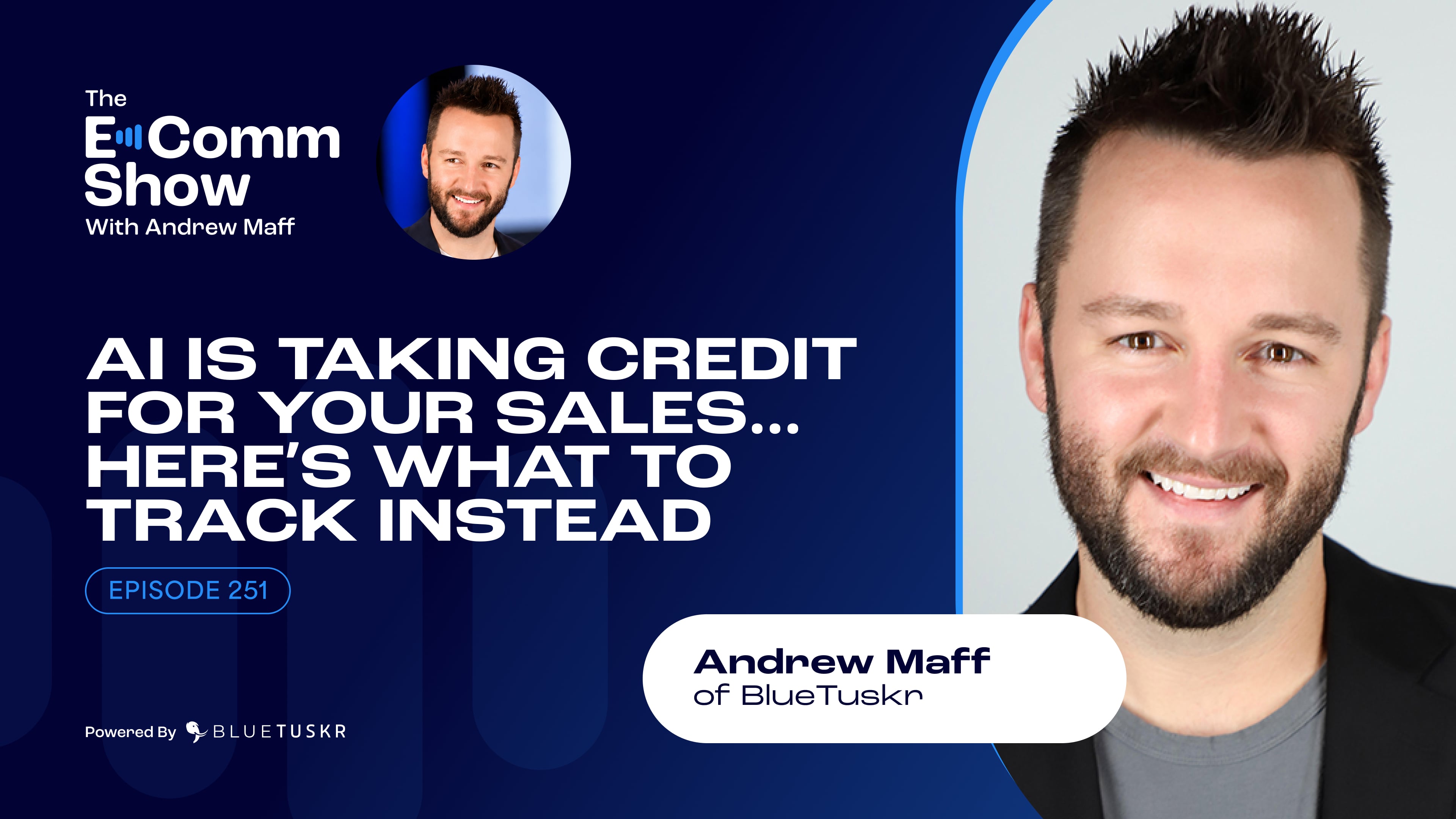
Your top-of-funnel marketing is still working…but AI is quietly taking the credit.
In this 251st episode of The E-Comm Show, host Andrew Maff breaks down how AI shopping is breaking attribution, from Amazon’s AI driving 40% larger average orders and ChatGPT fielding 99 million shopping searches a week to AI assistants getting product details flat-out wrong, AI ads claiming sales that were already happening, and the shrinking value of ROAS.
From the AI platform race between Amazon, Walmart, Meta, and OpenAI to brand halo tracking, listing optimization, and MER, this episode explores why 2027 could be the beginning of the end for attribution as brands know it.
If your Meta ROAS looks terrible but cutting ads makes everything else drop, this episode is a wake-up call to stop chasing channel-level credit and start measuring your marketing as a whole.
What You’ll Learn
-
The AI Shopping Explosion: How usage of Amazon’s AI doubled twice in under a year, with AI-driven orders averaging 40% more than traditional search.
-
The AI Platform Race: Why Amazon blocks outside AI from indexing its catalog while Walmart opens its doors, and what that reveals about who will own AI-driven shopping.
-
Why Attribution Is Dying: How Amazon’s closed data, cross-device shopping, and a fluid customer journey make it nearly impossible to tell what actually drove a sale.
-
AI Is the New Middle of the Funnel: How shoppers discover products on Meta, TikTok, YouTube, or TV, then ask ChatGPT before buying, so AI gets the credit your top-of-funnel ads earned.
-
When AI Gets Your Product Wrong: How a live test of five brands’ products surfaced AI answers that misstated waterproofing, age guidance, and side effects, and why most brands have no idea it’s happening.
-
Fixing What AI Says About You: Why listing and product page optimization is now ongoing work, and how pulling in reviews and customer sentiment helps correct what AI tells shoppers.
-
RIP ROAS: Why brands need to stop judging top-of-funnel channels by ROAS and start tracking MER or CAC-to-LTV ratio, including how pausing one “zero-purchase” Meta ad dropped a brand’s Amazon sales 38% overnight.
-
Marketing Like It’s the Mad Men Era: Why Andrew believes Q4 2026 kicks off mainstream AI shopping, and why brands need a message that connects with customers wherever they choose to buy.
Watch the full episode below or visit TheEcommShow.com for more.
If you enjoyed the show, please rate, review, and SUBSCRIBE!
Have an e-commerce marketing question you'd like Andrew to cover in an upcoming episode? Email: hello@theecommshow.com
WATCH ON YOUTUBE
Episode Transcript
iconAndrew Maff 00:00
Hello, everyone, welcome to another episode of the E-comm Show. As usual, I'm your host Andrew Maff, and today I'm going solo, and I'm going to talk to you about something that I think is probably going to be one of the biggest changes we've seen in e-commerce in I don't even know how long. Probably since the iOS change, when attribution was going out the window, which ironically is pretty much what I'm going to be talking to you about today. Or since Amazon decided they wanted to increase fees every five minutes, or, obviously, since the birth of AI and us using it regularly within our own businesses.
But what I wanted to talk to you about today is not necessarily the use of AI internally, but more externally. I don't know about you, but I'm personally already tired of hearing about AI. However, it obviously does fantastic things, so it's very difficult to hate on it when it does all of these amazing things for your business and helps you grow and helps you scale and helps you get things done a lot faster. But at the same time, it's like constantly banging your head against the wall: you can't sneeze without someone saying "AI," and it's getting really out of hand. Either way, I digress. Here's what I wanted to talk to you about.
In Q4 of 2025, Amazon announced that the use of their AI on the platform from a consumer perspective had doubled since the last time they discussed it, which I think was Q2 for them. I want to acknowledge that doubling one is just two, so when it's a small number, doubling is not really that impressive. However, then came Q2 of 2026. This was right off of Prime Day, and Amazon announced that the use of their AI had doubled yet again, and that the average order was up 40% for anything that was purchased via the AI as opposed to traditional search. So not only were they seeing another jump in adoption, but they were seeing people actually purchasing more through it. Then we just had their Q3, and they announced that the use of the AI has obviously increased yet again. And I am anticipating, because of how much AI has been driven into everyone's heads over the past year, that we're about to see a significantly larger influx in the use of AI on Amazon.
Now let's talk about off Amazon. ChatGPT has over 1 billion weekly users globally. They have 99 million weekly searches on something related to shopping. Then Muse, Meta's little AI thing, was announced, I think, a couple of months ago at the time of this recording. It had more downloads in the first week than ChatGPT did when it was announced, and it was natively integrated with Shopify, so it has the ability to showcase products and let people purchase directly through there. Walmart, as of a month ago when this goes out, if not more, announced that they're allowing the LLMs to pretty much index all of Walmart. Amazon decided not to do that. Amazon is not allowing ChatGPT or Perplexity or anything like that to really index Amazon. However, Amazon is now running ads within ChatGPT. So it's becoming a whole war of AI, right? Are the AIs going to consolidate, or are there going to be so many of them that it becomes this nightmare of competition, with everyone having their own personal preference on which AIs to use?
It's typical of this type of thing. It's the same thing as when social media came out. All of a sudden, there was a ton of social media platforms, and there were a lot of people on them. Sometimes people would jump on them real fast and download them, and then they would stop using them. I don't know if anyone remembers the new MySpace that came out. MySpace died out, and then all of a sudden you had Facebook, Instagram, Twitter, Pinterest, there was something else, and MySpace wanted to get back into the game, so they came back out. There was a ton of stuff, right? People will hop on, but adoption is the harder part. So the question obviously becomes what's going to happen down the line.
I think Amazon has taken a very interesting move. Amazon knows that they are an amazing search engine for products. If you want to buy something, they want you to think, "I should go to Amazon and see if it's on Amazon." The reason they probably don't want these other AIs indexing Amazon and showcasing Amazon products is that they don't want the user to get used to going to ChatGPT or Gemini to shop for Amazon products. They want them to go to Amazon to do that. And if the ease of shopping through AI is what the consumer wants, that's totally fine, because Amazon now has their own AI. And obviously, if you go onto Amazon's app, it's driven down your throat. So I find that very interesting.
Then you have the people doing the opposite. Walmart has now allowed everyone to index anything that it wants, and they're taking the exact opposite approach: "Have at it. If you want to get into Walmart, go for it. Everyone and their mother can index us. It's great, right?" Muse has been pretty specific to Shopify for now, but from what I've heard, they're also just like, "We'll take anything," and I'm pretty sure they actually have the ability to index Walmart also. So here's where it gets kind of interesting, right? What will happen? If I were to redo this episode two years from now, or, with how fast this stuff is going, it might even be the end of next year, I'll bet Muse dies off. I'll bet ChatGPT does a relationship with Shopify, maybe even Perplexity, although I could see Perplexity dying off. Then Gemini starts to open up more opportunity as well, and Amazon sticks to their guns and stays the way they are.
I think we'll start to see some of the other AIs fall off. I don't think Muse will make it. That's my own opinion. I know that a lot of people adopted it, but I just don't see it really taking off. I downloaded the new iOS, and Siri is still garbage, so I don't think anything is going to happen there. I think Siri might get closer with ChatGPT and just become an extension of that. But either way, I digress. What's going to happen? We're going to see consolidation. Some may fall off, and some may actually literally consolidate. The users are going to get used to using AI for certain platforms.
I've always said I expected an explosion of marketplaces, and I think it wasn't as much as I expected, but I still see more and more of them popping up. You have Amazon, which is basically like, "Hey, we sell everything," right? But then you have Wayfair, which is very specific to home goods. Then you have Chewy, which is very specific to pet supplies. Then you've got Home Depot, which is very specific to DIY home stuff. All of these existing stores and marketplaces have popped up and become their own marketplace and decided, "We're going to pick an audience." I think the same thing is going to happen with AI. Amazon is still going to be "If you want to buy anything, come to us and use our AI." But then you're going to see AIs be more like Claude is specific to work and ChatGPT is specific to your life and things like that. That's just an assumption, but it's worth getting ahead of.
Either way, what's going to end up happening is that these AIs are still going to have these capabilities. So here's something we've found very interesting. We've always been very obsessed with trying to monitor brand halo. We actually came up with our own platform that essentially integrates specifically with Amazon, and a little bit of Walmart right now, and then Meta, TikTok, really anything top of funnel. What we do is evaluate, as you increase ad spend or increase overall reach, even if it's coming from more organic initiatives, how much it's affecting brand search on Amazon or even on Google. So we can evaluate the halo lift and come up with our own metric around what that effect looks like, so that when we're looking at Meta ads and it says the ROAS is crap, but the reality is you've got people leaving and going to Amazon, we can actually evaluate that, right?
Well, we have a new problem, and the new problem has made things even more complicated. This is where I really want to hone in on the theme of what I'm getting at here. I think attribution is dead or is dying. I think 2027 is going to be the beginning of the end for attribution. You already have a nightmare scenario with attribution when monitoring top-of-funnel marketing initiatives that are driving traffic to Amazon, whether on purpose or not, because Amazon doesn't share their data, so you have no fucking idea if they actually converted or not. But even on top of that, you have people doing stuff outside the attribution window. You have people hopping around on different devices. You have all these different problems, and the consumer journey is so fluid that it becomes basically a nightmare to evaluate what actually got you the sale.
And then even on top of that, should you even be counting individual things that got you the sale? Yeah, it was a Meta ad that they clicked on, but maybe they heard about it from a friend, and the friend saw it from an influencer, and then they decided, "Yeah, I might want to do it," and then they happened to get targeted by it, and then they got the email and they converted. There are 500 different ways it could happen. So giving one individual channel all of the credit for a sale is ridiculous in the first place. But how is all of this related to the AI side? This is where it gets kind of interesting.
As we've monitored these brand halo effects, we're now seeing more and more people converting through AI, and it tends to be correlated to how much top-of-funnel activity the brand is doing. For brands that have a product that is a commodity, something where people know it exists and so they're searching for it, or they're asking their AI about it, and then the AI suggests it and they go and purchase, those are pretty standard. It's the ones where you have to educate the user. It's the ones where you need to differentiate from your competition. It's the ones where you have a completely new product, maybe a new solution to a problem people have. Where you have to educate the consumer, you're leaning heavily into more top-of-funnel channels, ideally, or specifically, Meta, TikTok, YouTube, or even TV, anything along those lines where you're educating the audience to think about your product. They are leaving those platforms, and instead of going directly to your website or going to Amazon to search for it and doing their own due diligence, they're now letting the AI do it.
So now what's happening is they're learning about your product, let's say from an influencer on Meta, and they're leaving Meta and going to ChatGPT and asking ChatGPT about it. ChatGPT is going to tell them all about it. ChatGPT is effectively going to act as your best salesperson in the world, and they're going to be wildly convinced, because the conversion rates coming out of LLMs are obscene. They're going to go to your website because ChatGPT is going to give it to them, and they're going to convert. And you're going to go, "Holy shit, we need to invest a ton of money into LLMs and what we can do to show up on here," and blah, blah, blah. In reality, while yes, that is partially true, because you want to make sure it's accurate, it's also your top-of-funnel stuff. But you're going to say that influencer drove nothing, or those Meta ads did nothing for us, the ROAS looks like crap. Then when you kill those ads, you're going to see your LLMs come down with it. So now we've thrown in a middleman. There is a middleman from the top of the funnel to the bottom of the funnel. The middle of the funnel is getting all taken up by these AIs, so it's causing a whole new problem.
On Amazon specifically, where it's causing a problem, I'm calling BS on most of the ads, because they're running ads for your products within Amazon's AI. If you convert through one of the ads, or if someone asks specifically about your product and Amazon shows your product within the AI, it's going to convert and Amazon's going to take the credit, but they were probably going to convert anyway because they're already asking the AI. And as we know, people come out of AIs at a much higher conversion rate because the AI has essentially convinced them to make a purchase.
The problem, which I'll go on a different tangent with, and this will go out, I think, in November-ish, is that in early November I hosted a webinar specific to Amazon's AI shopping. One of the things I wanted to show is how you have to make sure that your listings are in a good spot. And it's the same thing off Amazon: you have to make sure that your product descriptions and everything are extremely clear and addressing a lot of what the internet is saying from a DTC perspective, and, from an Amazon perspective, what reviews are saying outside of just your listing. I took five attendees, and I took five of their brands. They were all different brands, and I asked three or four different questions. It was four different questions: three specific to their product and one more category-level. On the category-level question, four out of five brands didn't show up as an option at all. Their competitors showed up. And then two out of the other three product-specific questions, for every single one of those products, were wrong.
One of them was clearly stated in the title as a waterproof product, and Amazon's AI was just like, "No, it's not." Another one clearly stated in its product listing that it wasn't meant for kids under 18 months. So I asked, "Is this good for a one-year-old?" And it said no. Then it said, "However, it can be good for 18 months and under." And then another one said, "You have to be three and over." All within the same answer, or something along those lines. It was basically all fucking wrong.
And then there was another one. This was my favorite. I'm lazy. I hate going to the grocery store. It's one of my least favorite things, so I'm one of those people who orders my groceries from Whole Foods. I had my groceries in there, and I didn't even realize it, but for one of the products, it just assumed that I was vegan. And in my cart I had so much chicken. I had so much chicken in there, for meal prepping for the week or something. I was like, "Not only did you just randomly assume that I'm vegan, but I'm definitely not. You could see that in my active cart." And then there was another one, a supplement. I asked it, "Does this product make you nauseous if you haven't eaten when you've taken it?" I worded it something like that. And it was like, "No, it doesn't," and it mentioned a few things. Then I asked it another question, and before it answered the second question, it said, "I need to reverse my answer." It basically said, "Actually, it can make you nauseous," and blah, blah. It had basically lied to me. So literally, most of the AI answers were wrong.
So now we have this new problem, where consumers are going to learn about a product on Meta, TikTok, TV, wherever the hell, top of the funnel, and then ask their AI about it. A lot of brands are not realizing that this AI is wildly inaccurate about their products, because they're not optimizing their product listings or their Amazon listings based on customer sentiment. So your best salesperson is now not only ruining attribution, because you have no idea where that person actually came from, but they're also potentially lying about your product.
Now, here's the thing: brands will catch up. Brands will understand that. And I can tell you how to do this, by the way. It's very easy. Whether you're off Amazon, on Amazon, wherever the hell you are, it doesn't matter: pull in customer sentiment, pull in reviews, and see what people are saying about your product, whether it's true or not, and then address it. That's all you've got to do. It's not that hard. On Amazon, we integrated with Seller Central, so we pull in all the reviews and can see what people say. If people say something about the listing in a review that is live, and it's wrong, and we don't reference it in the listing, then we just make sure to go in and reference it. That's all you've got to do. But there are billions of products out there that everyone has to go through and start cleaning up, so it's going to take a little bit of time. For the next couple of years, this is probably going to get a little ugly.
Optimizations are now a constant thing. They need to be constantly updated and constantly addressed, because as people are leaving reviews and talking about you, you have to make sure that you are stating facts, even if the consumer is saying things that are inaccurate. So listing optimizations, product optimizations, the whole SEO world has actually gotten even bigger now, because you have to make changes on a regular basis, not just "Hey, I did it last year, so it should be fine." I've obviously gone off on a tangent on SEO stuff, but the attribution side is where this is going to get very interesting.
You just can't... ROAS is stupid. Going into 2027, let's just admit ROAS is dead. RIP, ROAS. It's gone. At this point, I really don't know if it's going to tell you that much. You might be able to claim... You're going to need to have view-through attribution, because they're going to leave the platform. So in 2027, you have to start looking at your MER, your marketing efficiency ratio, or a CAC-to-LTV ratio if you've got more of a consumable product. Quick lesson here: MER is overall ad spend versus overall revenue. That's it. Here's what you spent on all of your marketing initiatives, between Meta and TikTok and influencers and email and SEO and blah, blah, blah, versus your overall revenue. You need to have a target MER. That's what you've got to go for. And then you need a marketer who understands, unless you do it internally, what the purpose of those channels is. If the purpose of the channel is to educate and bring in top-of-funnel traffic, you shouldn't be looking at ROAS, because chances are anyone who's willing to convert from that stuff is leaving and going elsewhere.
I can give you a really broad example. We had a brand we were working with, and we were doing a ton of top-of-funnel stuff. There was a specific ad that we knew was not only feeding middle-of-funnel retargeting but also driving a ton of traffic to Amazon. The link wasn't taking them to Amazon. We just knew, from the data, that these people were coming from Amazon, based on what they were searching and things like that. The client we were working with was adamant: "Turn it off. It's not converting." Within Meta, it literally showed zero purchases over the course of a month. She was adamant that she wanted to hit a certain ROAS, and she wanted to see Meta ROAS here. So the logic was, okay, we're going to kill that ad. We didn't want to do it, but they were adamant, so we killed the ad.
I shit you not, within 24 hours, Amazon tanked 38% overnight and stayed down. It didn't bounce back until a good two or three days after we had finally turned the ad back on, after we convinced her to relaunch it. Something else that was missing was her overall net new email subscribers on a weekly basis, which tanked as well, because you had people who were more top of funnel. They were coming in showing interest, subscribing, but weren't ready to pull the trigger yet. And then even on top of that, the orders she was seeing come through AI were gone, down to zero. So literally all this top-of-funnel stuff had tanked the rest of the business, because we were so focused on what Meta was saying the ROAS was, and it was so wildly inaccurate to focus on that.
And that is just a minute, small example of how this is going to get exacerbated in 2027, because the average consumer is going to be so much more interested in using AI to help them shop. I think this Q4, Q4 2026, is going to be the beginning of that. The average consumer has had AI shoved down their throats at work, no matter where they work, at pretty much every turn. So they're finally going to sit down and go, "I always struggle to find something for Dad. Let me use AI." They're going to talk to the AI, and it's really going to help them find a cool product that they could buy for their dad for Christmas or whatever. They're going to see how AI makes shopping that much easier, and then all of next year, that's where it's going to take off. It's going to be this huge trickle-down effect of average consumers using AI all the time to do their own due diligence on what product they want and what is best for them, because they're convinced that this AI knows them better than pretty much anyone else. So that's where they're going to shop.
And so every marketer is screwed, because attribution is going to go out the window, because the AIs are all going to take the credit. That's what we're looking at. So start looking at MER, or your CAC to LTV, or both. Start looking at your overall marketing initiatives compared to your overall spend. It's how businesses did it 50 years ago, back in the Mad Men days. You never saw Don Draper get asked, "What was the ROI of that billboard I ran?" Because it's not a question. At this point, you have to develop a message. You have to find a way to make noise that connects with your consumer and just let your consumer shop wherever they want. Marketers have been spoiled from a digital marketing perspective for years and years and years, and that is going to be gone within the next year or two. I guarantee it. That's my opinion, and maybe I'll redo this episode a year from now. We'll see if I was right. But I would start looking at those numbers now, just to be safe.
But as usual, thank you all for joining me. Make sure you do the normal thing: rate, review, subscribe, all that fun stuff on whichever podcast platform you prefer, or head over to theecommshow.com to check out all of our previous episodes. As usual, I will see you all next time. Have a good one!
Narrator 22:08
Thank you for tuning in to the E-comm Show. Head over to theecommshow.com to subscribe on your favorite podcast platform, or on the Bluetuskr YouTube channel. The E-comm Show is brought to you by Bluetuskr, a full-service digital marketing company specifically for e-commerce sellers looking to accelerate their growth. Go to Bluetuskr.com now for more information. Make sure to tune in next week for another amazing episode of the E-comm Show!
CONNECT WITH OUR HOST
AndrewMaff.com | Twitter: @AndrewMaff | LinkedIn: @AndrewMaff
Connect With Us





Recent Post

- Nov 11, 2026
- Author: Andrew Maff
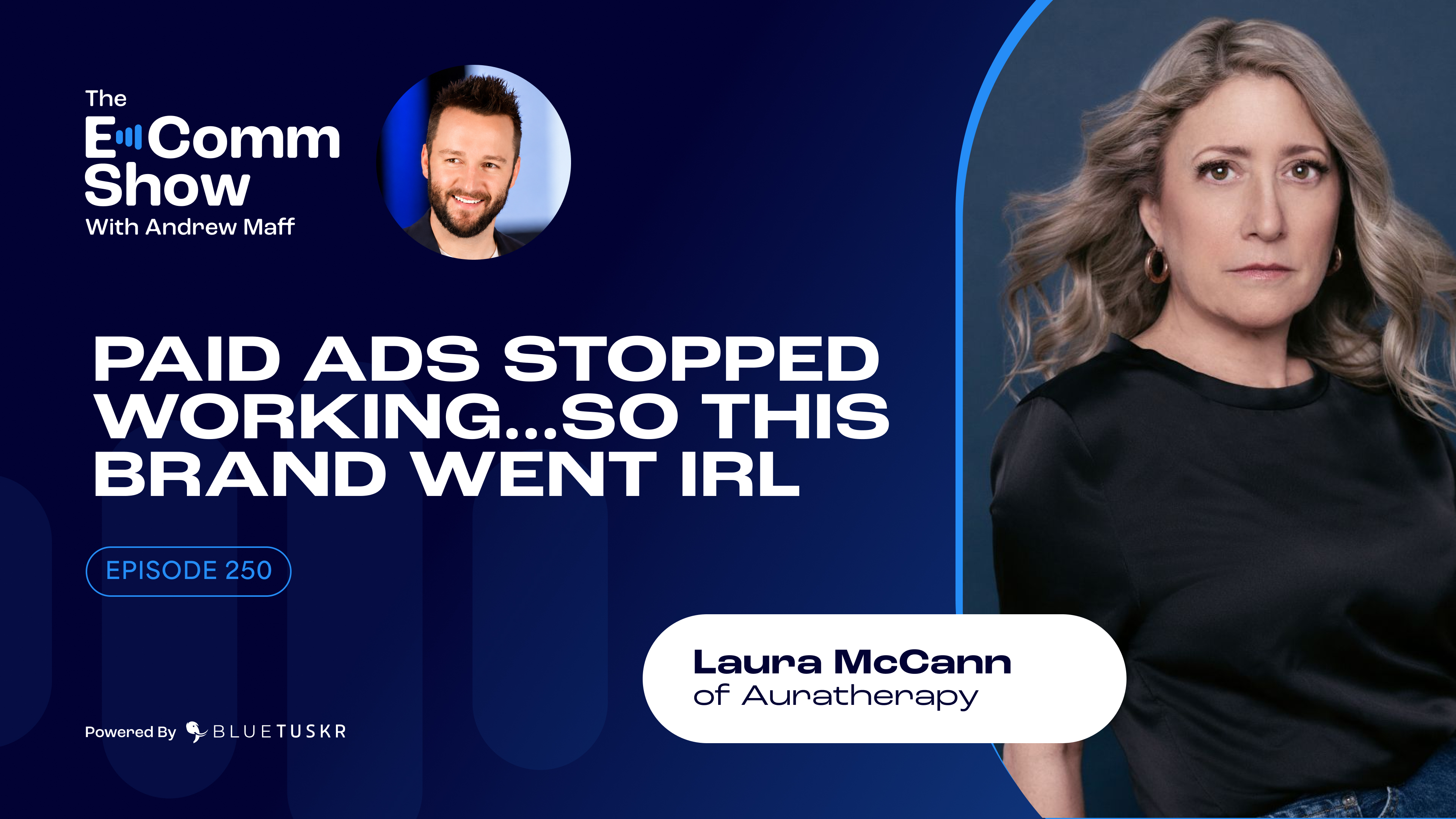
Paid Ads Stopped Working…So This Brand Went IRL | EP. #250




Tell us what you think!