



LISTEN NOW





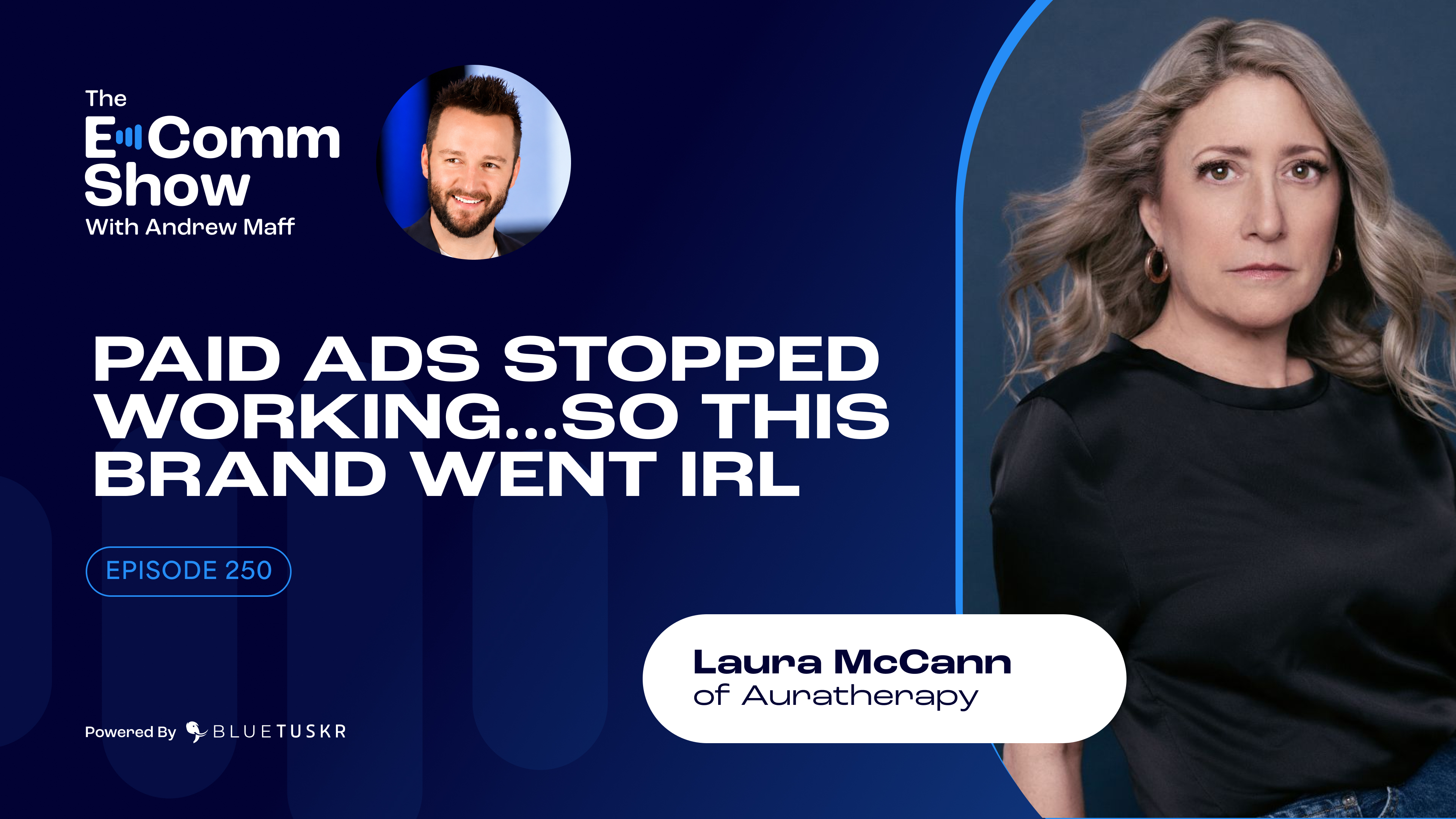
Most brands spend heavily to acquire a customer…Laura McCann found a way to get customers to pay for it.
In this 250th episode of The E-Comm Show, host Andrew Maff sits down with Laura McCann, Founder & CEO of Auratherapy, to talk about building an omnichannel wellness brand, from experiential retail, events, and luxury spa partnerships to bootstrapping without investors and rebuilding after Hurricane Helene wiped out the company’s entire warehouse.
Laura shares why she pulled budget out of Meta and TikTok and into in-person events, how a $95 aura reading turns into full-margin product sales, and how AI is helping her build proprietary software and more personalized customer relationships.
If paid ads are draining your budget or your product is hard to sell online, this conversation is a reminder that your best acquisition channel might be in the room with your customer.
What You’ll Learn
-
Pairing a Service With a Product: How Auratherapy combines aura and chakra readings with aromatherapy to create product attachment that a pure-play DTC model struggles to replicate.
-
Scaling Nearly 20,000 Readings Into Software: Why Laura’s team is building its own platform, with a software-as-a-service version targeted for March, to bring the experience into spas, resorts, and events.
-
Bootstrapping Through a Disaster: How losing an entire warehouse of inventory to Hurricane Helene led to a full rebrand and a two-year rebuild with no investors or partners.
-
Why In-Person Feedback Beats Online Data: How being customer-facing across retail, events, and wholesale gives Laura insight that reviews and dashboards miss, and why her returns are close to zero.
-
Customers Who Pay to Be Acquired: How charging for the aura reading, then selling product at full margin, flips the traditional customer acquisition model on its head.
-
Trading Paid Ads for IRL: Why Meta and TikTok never delivered a profitable ROAS, and how nine Miami events, an ambassador program, and product gifting took their place.
-
Launching a Second Brand: How Moodzee gives Laura a simpler, Gen Z-focused story to test a traditional DTC, TikTok, and Amazon strategy that Auratherapy couldn’t.
-
Experimenting Like Your Own Investor: Why Laura runs 90-to-120-day experiments and treats every self-funded dollar with an investor’s discipline.
Watch the full episode below or visit TheEcommShow.com for more.
If you enjoyed the show, please rate, review, and SUBSCRIBE!
Have an e-commerce marketing question you'd like Andrew to cover in an upcoming episode? Email: hello@theecommshow.com
WATCH ON YOUTUBE
ABOUT THE GUEST
Laura McCann | Founder & CEO, Auratherapy & Moodzee
Laura McCann is a serial entrepreneur, author, and retail innovator with over 30 years of experience spanning fashion, technology, consumer products, and e-commerce. As Founder and CEO of Auratherapy, she is building a next-generation wellness and fragrance company that blends aromatherapy, technology, and experiential retail.
With a vertically integrated business spanning DTC e-commerce, Shopify, physical retail stores, manufacturing, and luxury spa partnerships, Laura brings a unique perspective on building and scaling an omnichannel consumer brand. She is also the founder of Moodzee, an emerging fragrance brand designed for a new generation of consumers.
Passionate about AI, digital transformation, brand building, and customer experience, Laura is rethinking how emerging brands can leverage technology, data, and creativity to compete and grow.
Now in her 60s, she is proving that entrepreneurship, reinvention, and innovation have no expiration date.
Episode Transcript
iconLaura McCann 00:03
And then this is always the challenge: how do you find the right people to provide you that service? So whatever it is you're spending or doing, you feel at least that you learned something.
Narrator 00:13
Welcome to the E-comm Show podcast. I am your host Andrew Maff, owner and founder of Bluetuskr. From groundbreaking industry updates to success stories and strategies, get to know the ins and outs of the e-commerce industry from top leaders in the space. Let's get into it!
Andrew Maff 00:28
Hello, everyone, and welcome to another episode of the E-comm Show. As usual, I am your host Andrew Maff, and today I'm joined by the amazing Laura McCann, who is the founder and CEO over at Aura Therapy. Laura, how you doing? Ready for a good show?
Laura McCann 00:39
Yeah, thanks for having me.
Andrew Maff 00:41
I am so excited to have you on the show. I recently learned a little bit more about this, and I'm very excited to learn from you and learn a lot about the business. It's also a little bit different from your standard e-commerce business because I know there's a retail element and all this other stuff. So I'm super excited to get into it. I usually like to start these off relatively stereotypically, just give you the floor, and have you tell us a little bit about your background and how you got started with Aura Therapy, and we'll take it from there.
Laura McCann 01:08
Sounds good. I guess I consider myself a wellness entrepreneur, enjoying building an omni-channel business in the wellness space. Wellness is getting some rays of sunshine on it. I'm in the adjacent beauty industry because the products that I make and sell are aromatherapy. Think of it as fragrance that's good for you, made with essential oils. It's a new take on aromatherapy, which is a huge multibillion-dollar online business. Think of all the MLMs. Think of Amazon. But this is a little different take on it. We combine aromatherapy with an experience, which is an aura and chakra reveal, and also a data-informed take on aura readings. The two create an experiential business that we do primarily in a retail setting and at events. There's a whole wholesale piece to the business where we train spas and hospitality clients, mostly on the luxury side. And then there's a DTC piece, which, with scent, is always really interesting because it's very hard to sell scent online. The reason for all the channels is that we figured that out, and we've picked channels that we can really leverage to build the online piece of the business.
Andrew Maff 02:28
Gotcha. And how did you get here? How did you start?
Laura McCann 02:31
I'm a serial entrepreneur. I started in my 20s and I'm now in my 60s, but I've always been an early adopter of technology. I've always built products and was strong in supply chain and tech in the retail and apparel industry. I didn't want to stay in that part of the business, so I moved into consulting. But then I love wellness. I love personal transformation. I saw an opportunity to take all the things that I love and have them converge into a business. At this point, if I'm in a business, which, as we know, is heavy lifting, a lot of investment of time, money, and energy, it had to have a place for all the things that interest me. And Aura Therapy does that really well. So I'm passionate about, you know, how to use branding, social media, marketing, ecomm, and AI now, right, to figure out and solve the problem of how to scale a brand.
Andrew Maff 03:32
Yeah, that's so much stuff. Honestly, it's obviously a good thing that it's something you're passionate about. I find that most of the entrepreneurs we have on the show are passionate about what they do, and when you think about it, when you're an entrepreneur, you're working all the time. So it needs to be a little bit of both work and a hobby at the same time. Yeah. So it's a very, very cool idea. Tell me a little bit about the experiential side of it first. You have, I believe, two locations as of right now, correct?
Laura McCann 04:04
Correct.
Andrew Maff 04:04
So tell me about what happens there, and then how does that bleed into online?
Laura McCann 04:09
Yeah, great question. So I don't know, have you ever had an aura reading or an aura photo?
Andrew Maff 04:16
I haven't, but my wife is part of a book club. She just did this like two weeks ago, and I was like, "I know this now."
Laura McCann 04:25
So everybody has energy. There's energy all around us. There are ways to capture the information from the energy field. Historically, it's been called Kirlian photography, and you can do that with special kinds of cameras, with hands on electroplates, and that is a method that's really beautiful. It creates a photograph. The challenge with that is that somebody has to interpret what it means, and it's very subjective and not very detailed. What we do is quite different. We use licensed software. It's not our software, but we have done almost 20,000 aura readings with this particular software, so I would say we're experts, and we built our own method for how to use the information from this system and this application to do really cool things around interpreting and reading energy. The system doesn't just show the aura, which is the colors around you. You can't see them with your own eye, but the system pulls in the data from hardware. You scan, and you see your colors, but not only your aura. We see your chakras. Many people may not know what the chakras are. If you do yoga, you might know energy in the body. There are seven main chakras. It tells you how that part of your mind, body, and soul is balanced, open, or not open, and the pattern that you're making energetically translates into how you feel and then how your life is going. So people really want to know this. I say it's like an EKG for your mind, body, and soul. The challenge is that you have to do it in person. It's not something you can do with a quiz. But because the data is so rich, and the opportunity to work with the client in this very intimate way is to reveal them to themselves, which is why we call it an aura reveal, it also creates an opportunity to make recommendations for products. We call that a ritual, and that creates product attachment, which sells products. A lot of people have a service, and a lot of people have a product, and tying a service and a product together in this kind of integrated way is the art of what we're doing. It's quite unique, very niche, I'd say, but it's incredibly compelling because the unit economics you see from DTC in the retail setting are hard to replicate in a pure-play DTC model.
Andrew Maff 06:50
Yeah, got it. Okay. And so it sounds like, and correct me if I'm wrong here, you are also now working with other businesses and essentially training them, and I'm assuming selling them the rights to be able to do the service, which is effectively driving traffic to offering product.
Laura McCann 07:08
Correct. So that's phase one. We realized that the method needed to be something that we owned in a more cohesive way, and of course, from doing that many aura readings, we had a wish list of things we wanted. So we are building our own software now, which is taking the reveal piece and building out our own interpretation layer, data sets, and different visualizations of the information so that we can own that chunk. In March, we hope to have our first software-as-a-service version. You still need the hardware and software to do the reading. That piece we don't do, but we now have an ability to scale it, and we are bringing that into hospitality: spas, resorts, events. It's quite an amazing monetization model for somebody who's looking for a way to create an end-to-end relationship with a consumer, and it has all the things wellness people want to capture that often don't exist inside of a system. You can hook it to CRM, you can hook it to booking, you can have a full-loop marketing system. So we're building that. It's really exciting. I love building software. I've done it a few times in my career, and now it's so different to do it because of AI. It's just a whole different way to build.
Andrew Maff 08:31
Yeah, that's wild. You definitely found a way to monetize every element of the step here. So between product and location and the experiential part, and now building software, like, that's not cheap. Did you get funded in the beginning? Do you have partners? Is this bootstrapped? Tell me a little bit about that.
Laura McCann 08:56
Yeah. So initially bootstrapped, and currently self-funded. Like many businesses, we had ups and downs, and the business is currently in a two-year incarnation where I have no investors and no partners, and I kind of restructured it. That came from a silver-lining horror story: we had our manufacturing in Asheville, North Carolina, and when Hurricane Helene hit, we basically lost our entire warehouse with all of our inventory. At the time, we had a different brand name. We had built the Aura Therapy brand as sort of a separate brand for the aura readings, as we were experimenting with whether these should be separate things. When that happened, and we had to re-up to go get inventory, we said, "Let's start bringing in Aura Therapy as the brand," because it really encompassed the entire experience. Then we bought product in and rebranded, and so that's been going on for about two years. It coincided with opening the second store in Miami. Miami is home base, and so yeah. As a result, my approach right now is that there are still always things I have to figure out. It's really great to not have people telling me how and what to do. If anybody had been in my shoes over the last seven or eight years of doing this, they would have told me to go left, right, here and there, and all of it would have been wrong, because I think for myself as a founder, I'm finding my sweet spot by having such a rich opportunity with retail and events and wholesale to be customer-facing. None of this is done in abstraction, right? I am so grateful that I actually have people who tell me if they like it. I can tell customer fit. I have all the anecdotes of what works and what they like. If it was just purely online, it would be all data, and it would be a very different kind of business. For myself, that might not be the right business. I think we'll get there, and it'll become very data-driven. But it's still currently very much like finding the thing, like truffle hunting, right? Where's the thing?
Andrew Maff 11:03
Yeah, yeah, I completely agree. The way that you're doing it is definitely something different from what I've heard, but I 100% agree. I think one of the biggest problems when everything is online is that the data you're getting in, especially customer sentiment, is mostly negative. If they really like the product, they're not going to take the time to leave a review unless they're a huge, huge fan. But then there's that midground where everyone wants to air their grievances and hope that you're going to give them a return or something like that. Very few are going to tell you everything they love about the product. So if you're not actually speaking with people, you miss out on some of that information, and it just becomes a blanket of negativity. A lot.
Laura McCann 11:48
People always say, "What are your returns like?" And I go, "We have no returns." Zero returns, or very few. If we did, we'd say we'll give you something else. The reason for that is that the whole journey is really authentic, and we're not selling a commodity product that they fell in love with on TikTok or something. It's not in their shopping cart because it's a guess. It's in their shopping cart because they're already warmed up. But that means you probably don't get... It's like fishing, right? You don't get a lot of the small fish in a big net. You're getting lots of good, juicy, really interested customers. The job now, we're finding, is to nurture those and to build different DTC metrics, because the store has metrics and the DTC has metrics, but we're coming up with what this new playbook of metrics looks like, where we're borrowing across channels and saying, "Can we have attachment in the store? What does that look like? Can we have return customers? Can we have referrals?" All of those things are calibrated with a little more of a retail focus first, which is kind of interesting.
Narrator 13:00
Is your e-commerce business experiencing falling revenue? Bluetuskr has helped many brands like yours excel. Unlike other marketing partners, Bluetuskr leverages a team of specialists to ensure every strategy is created and executed toward your business growth. As an extension of your marketing team, Bluetuskr prides itself on helping to fill in the gaps and develop strong omni-channel strategies to diversify your business from the rest. Ready to scale your marketing initiatives? Visit their website, Bluetuskr.com. That's B-L-U-E-T-U-S-K-R.com.
Andrew Maff 13:33
So I imagine... It sounds like you're kind of focused on a CAC-to-LTV ratio, but in your scenario, it could be a bigger upfront spend from the service and the software, and then it's dwindling off, at least from a revenue perspective, on the product line. However, it's kind of elongated. Am I right?
Laura McCann 13:53
Yeah, exactly. If you were thinking of it as a typical DTC play, you'd probably be looking at a big advertising spend as well, and trying to figure out your ROAS and your customer acquisition costs. What we did is experiment with those channels, which we've done multiple times, and we saw they did not create any kind of beneficial ROAS. They just sucked money out the door. We said, "Where can we take that money and actually be in front of people?" because we like the IRL, right? So this year in Miami, where we have a bigger store, we started by doing events in the store, and they really were not scaling the way we wanted. We decided to do bigger events, because that's kind of a Miami thing, and we did nine events this year. We built out a community. We're building out an ambassador program with real people, and we're gifting in those scenarios. We've now even converted that to customers. How we acquire them is content acquisition. We're more interested in them creating really great, relevant content, but we're educating them on the product. So we've reversed all the spend into a different way, and we use product gifting as customer acquisition. The aura reading in itself is a kind of amazing thing because you always want that razor-and-blade model. If you were doing, let's say, a skincare cream and selling it in a big-box beauty chain, and you wanted to give them information on what to buy, you would probably give away for free the diagnostic about their skin being dry or greasy or whatever. So you still have to acquire that customer off of the product margins. We can charge for the aura reading, currently $95. The price has just gone up and up and up with no pushback at all, and then we sell a product at full margin. So they paid to be acquired with their own money. That's magic. The question now is how to scale that in a way that still sounds authentic, and a lot of it is traffic, right? How to get traffic.
Andrew Maff 16:02
Well, I was shocked to hear that you said you tried Meta, TikTok, and stuff in the past, and that those didn't work out for you.
Laura McCann 16:08
Did not work out. We're still trying. We still want to try. It's hard to understand what we do. There may be more understanding of what we do now, but it's still kind of like, "What is all this?" If somebody hasn't experienced it, they don't really know what aromatherapy as fragrance is. They maybe don't understand what an aura reading is, and again, they can't have an aura reading unless they're in person. So that limits the story. We created a new brand. It's brand new. We launched it a few months ago in New York at a trade show called Byte that's run by Beauty Independent, which is specifically for the beauty industry, and we created a simpler story for what we think of as our DTC, big-box, masstige aromatherapy story. It's all leveraging simpler storytelling, but with packaging that's super relevant, Gen Z, and very unique. There we're going to go back in and try a typical DTC play, TikTok, all the things, right? An Amazon strategy. If we learn on the back of that, I'm sure we can take that to Aura Therapy. But we're really building that as its own new brand. Part of the reason is that it's so hard to scale Aura Therapy. Initially, I thought we were going to scale it through our own retail stores. What ended up happening is that we're now scaling it through training other people, then the software model, and then product wholesale. That's how it's become. We may open more stores. Having stores is hard. They tell you it's hard. Stores do really well, but it's still really hard and almost a whole different business. So I feel like I have a lot of different business verticals, and marketing has to work across all of them, which is also a big push on the marketing team because they have so much to do.
Andrew Maff 17:58
Yeah. Well, I can imagine, too, because you basically have at least two different customers. You have the one that's already familiar with the product line. They're probably easier to go after on the DTC side, but there aren't that many of them. So you almost have to geo-target around the ones in an area where you have someone who's trained on how to do it. Then you have the people who have no idea what this is, but you think that based on targeting, you could get them there. They definitely have to be within an area where you have someone who's licensed and can actually go through the service with them and start the process. So I could see how that's a different approach. When you were doing that, were you leveraging influencers? I could see this being... I mean, you mentioned you were doing content creators, so I would...
Laura McCann 18:41
We were doing all of that. Obviously, we were trying to scale influencers to a certain point. I think maybe we were doing 50 to 100 gifting and creating all the content, and some of it was whitelisted, but none of it really worked because I think the foundation of the brand wasn't there. You're not in a Sephora or an Ulta, so they're not finding you. Where are you? So I think we had to go back and say, "Okay, let's be disciplined about it." Just because it works for maybe 80% of other people, and even that's suspicious, I don't know if it does. For us, we need to build something that's in the IRL before we can build that piece, and then it can become a replenish business, or a discovery business, or a gifting business. We see that after somebody has come in, they buy more stuff and they come back. So we have really great repeat customers. But it's that first initial customer where we capture a lot of revenue in the retail experience. It's not like they're going to come back in 90 days and buy it all over again. It takes a while to use up your aromatherapy. So what's interesting about the new model with the software is that we're really looking at how to create a more continued relationship with them. I'll call it CRM concierging. It's customization, but it's also giving them more, because we know who they are, we know what's going on, and we can be more like a therapist. We call our aura readers aura therapists, right? A lot of this is now going to be built into more of an email strategy that's much more customized. AI is great because so many of these things you can't do without AI. With AI, you can do lots of stuff. That doesn't mean it's easy to implement and operationalize, but you can certainly do it on the content side and in ideating new ways to be impactful. You can just keep going until you don't have any more money or you lose your team because you're tired of working so hard, or whatever. But I think we're all trying to figure out how to scale to this new way of working, right?
Andrew Maff 20:48
Yeah.
Laura McCann 20:48
But AI in the ad world, too, is something that I'm really curious about because I haven't done it yet. I think when I got off the ad platforms, it was probably a good year and a half ago, and we took that budget and moved it to events and other things. But it's changed so much in the last year and a half. I'd love to go back in. And then this is always the challenge: how do you find the right people to provide you that service? So whatever it is you're spending or doing, you feel at least that you learned something. Maybe you weren't successful, but at least you learned something you didn't learn the last time.
Andrew Maff 21:27
Yeah. I could get on a whole rant on that whole area. I know the biggest problem right now is that attribution is effectively dead. ROAS is almost like a vanity metric at this point, especially for things like Meta and TikTok, when people learn about stuff on Meta and TikTok, and then they go ask their AI about it, whichever one they're using. So the AI actually takes the credit, and you don't know if Meta and TikTok actually worked. It's a whole six more podcast episodes you and I could do on that. I love... Yeah,
Laura McCann 21:58
These are all fascinating conversations, because I think the thing is, and this has changed too, in your world and what you do, everybody said this is how it is, and now we know it's all these different ways. There's not one way, and every business is unique. So when you're looking for the use cases, even when I go into AI and say, "Pick five different brands who are doing this really well, and how are they doing it?" it goes and researches 50 websites, pulls all the articles, comes back, and tells me. But sometimes what it tells me isn't really how I wanted to understand it. So I can go down in the weeds of, "Okay, no, figure this out and figure that out." It's like having a conversation. On the other side of that, I'm way smarter, but I also don't know what to do next. So you've got to go back to, "Okay, what's the experiment? It's 90 days or 120 days. Let's do it, and then let's see what happens." Because I don't have a crystal ball, and nobody has a crystal ball, by the way. If somebody tells me they do, I'm already kind of suspicious.
Andrew Maff 23:02
Yeah. Oh yeah, tell me about it. But I do know, another podcast episode.
Laura McCann 23:06
Yeah, yeah. Capital is king. Having money to spend, money to experiment on all the things, is real. But you also have to be disciplined, especially when it's your own money, to pick good experiments, get out fast, and always behave like you're an investor for yourself, because otherwise it's funny money, right? It's a vanity thing. You can play up to a point, but it is a business. So what's the reward? Exactly.
Andrew Maff 23:35
Set the boundaries early.
Laura McCann 23:37
Yeah. Yeah.
Andrew Maff 23:38
Laura, this was great. I really appreciate you taking the time to chat with me. I know you're super busy, so I don't want to take up any more of your time. But I would love to give you the floor. Tell everyone where they can find out more about you, and of course, more about Aura Therapy.
Laura McCann 23:48
Yeah. On socials, it's Aura Therapy Life. The new brand is Hello Moodzee. The websites are the same names. We actually just relaunched our website today, so come check it out. And yeah, it's exciting. We'd love to have you DM us if you're in Miami. Let us know. Come to one of our events. We'll be having some in Asheville next year. So yeah, stay in touch.
Andrew Maff 24:11
Perfect, Laura. Thank you so much for being on the show. Of course, everyone who tuned in, thank you as well. Please make sure you do the usual thing: rate, review, subscribe, all that fun stuff on whichever podcast platform you prefer, or head over to theecommshow.com to check out all of our previous episodes. But as usual, thank you all for joining us, and we'll see you next time. Have a good one!
Narrator 24:29
Thank you for tuning in to the E-comm Show. Head over to ecommshow.com to subscribe on your favorite podcast platform, or on the Bluetuskr YouTube channel. The E-comm Show is brought to you by Bluetuskr, a full-service digital marketing company specifically for e-commerce sellers looking to accelerate their growth. Go to Bluetuskr.com now for more information. Make sure to tune in next week for another amazing episode of the E-comm Show!

CONNECT WITH OUR HOST
AndrewMaff.com | Twitter: @AndrewMaff | LinkedIn: @AndrewMaff
Connect With Us





Recent Post







Tell us what you think!